In recent years, SEO has grown from purely organic search to managing AI searches and “zero-click” searches. As such, ChatGPT, as one of the most prominent Large Language Models (LLMs) with around 900 million active users, has now become a pivotal part of SEO. That’s why it is so useful to learn not only how to use it for SEO research but also how to use it to gain organic traffic.
- What is ChatGPT?
- Why is ChatGPT useful in 2026?
- What should I use ChatGPT for in SEO?
- How to use ChatGPT for SEO
- The “Role - Context - Task” framework
- The “Gold Standard” framework
- Iterative prompting
- How to rank in ChatGPT
- The “Bottom Line Up Front” method
- Building citations on other high-authority sites
- Formatting for AI
- Common mistakes in using AI for SEO
- Key Takeaways for ChatGPT SEO
- ChatGPT and SEO FAQs
- Is using ChatGPT bad for SEO?
- Can ChatGPT do keyword research?
- How do I get my brand cited by ChatGPT?
- What is the difference between SEO and GEO?

What is ChatGPT?
ChatGPT is an Artificial Intelligence (AI) chatbot developed by OpenAI. Since its release in November 2022, it has revolutionised the SEO industry and shifted the goalpost for organic traffic. Its popularity as a Large Language Model (LLM) led Google and Bing, as well as others, to create their own LLMs such as Search Live and Microsoft Copilot, changing traditional SEO with the increase of “zero-click searches” and AI Overviews (AIOs).
Suddenly, AI-mediated searches were challenging traditional organic searches, which led to fewer clicks across the board. SEO wasn’t enough anymore. Generative Engine Optimisation (GEO) was also necessary, taking into consideration how to gain citations in AIOs rather than just focusing on organic rankings. User queries also changed from short keywords to long questions and complex, multi-clause prompts due to the use of AI assistants like ChatGPT.
Why is ChatGPT useful in 2026?
Optimising your content to appear in ChatGPT citations is now a vital part of SEO, and it has been found that there is a correlation between high Google rankings and being cited in ChatGPT responses; however, the two are not intrinsically linked. This means ranking high in Google does not guarantee visibility in ChatGPT, and to get the highest traffic for your page, you should be optimising for organic search and LLMs separately.
What should I use ChatGPT for in SEO?
ChatGPT isn’t only a tool for users; it can also be a powerful tool to use for SEO purposes. There are a number of ways ChatGPT SEO can help your business:
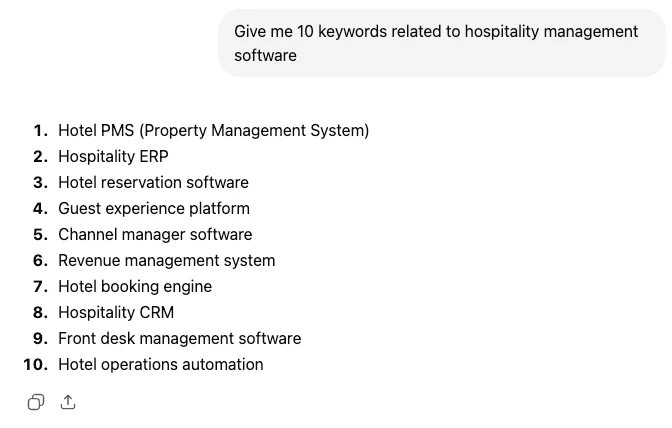
- Keyword research: ChatGPT, whilst not reliable when it comes to monthly search volume or keyword positions, can greatly help with keyword research by gaining semantically related keywords for your website, or even being used as a sounding board for potential new keywords, as shown below.
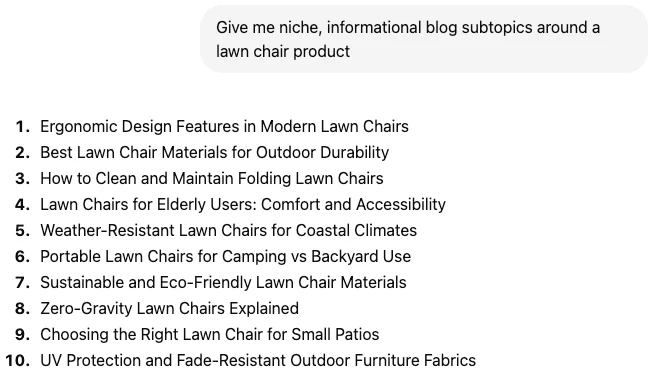
- Content ideation: ChatGPT is a good tool to input a broad idea and get back a lot of niche subtopics that could help with content creation, especially for a blog.
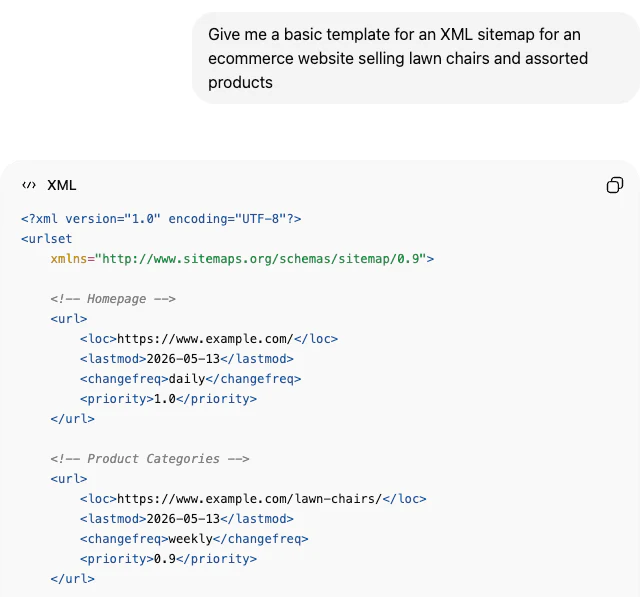
- Technical SEO: ChatGPT is a great way to understand the technical aspects of SEO and can help greatly with writing code or troubleshooting. Whether it’s generating schema markups, robots.txt rules, or XML sitemaps, an LLM is an easy way to streamline these processes.
- Metadata: Automating meta titles and descriptions for hundreds of pages can be done easily with an LLM like ChatGPT, whilst maintaining brand voice. However, this can also lead to “copy and paste” content that may negatively impact rankings, so be careful!
How to use ChatGPT for SEO
To get the most out of ChatGPT SEO, you need to learn how to formulate a prompt clearly and effectively. There are several ways you can do this, depending on what you want the LLM to do.
The “Role – Context – Task” framework
This framework is useful if you’re asking ChatGPT to act out a role, such as an SEO analyst or technical programmer. You provide the role the AI will be playing (e.g., an SEO analyst), the context for the work that you would like to be completed (e.g., a spreadsheet), and then describe what you would specifically like them to do. It should look something like this:
“You are an SEO analyst working for Impression Digital. The spreadsheet below describes the clicks, impressions, and click-through rate of our new blog, as well as the percentage change of these values MoM. Write a summary and key takeaways section for this data.”
The “Gold Standard” framework
By providing ChatGPT with multiple examples of your “gold standard” of work, from spreadsheets to reports, you are effectively training the AI in how you want your deliverables to look. This will strengthen the AI’s response to ensure that when you ask for a deliverable, you get what you’re looking for.
Iterative prompting
By simply talking back to the AI repeatedly, you can perfect their response over several prompts, explicitly altering and refining the tone of voice and wording of the deliverable until you’re happy with it. This method takes more time in the long run, but you have the flexibility throughout the process to change certain parts at your discretion.
Learn more about how SEO strategies can leverage AI like ChatGPT.
How to rank in ChatGPT
So, we know how to use ChatGPT to help us with SEO, but how do we rank in ChatGPT? Although the Google algorithm is always changing, there are a few things you can do to make it more likely that your page will be cited in LLMs.
The “Bottom Line Up Front” method
This method essentially means that the conclusion, recommendations, or anything else important usually found at the bottom of the page is moved to the top, so AI crawlers can find and extract it easily. This means having summaries or key takeaways that directly answer the key prompt of the page at the top is very useful in gaining AI citations.
Building citations on other high-authority sites
Like building general authority as you would in SEO, building up more citations across other external high-authority industry pages increases your topical relevance and gives you a higher chance of being cited in LLMs like ChatGPT.
Formatting for AI
Using descriptive headings, bullet points, numbered lists, and tables helps increase scannability for AIs, increasing the chance of your content being cited.
Common mistakes in using AI for SEO
- Hallucinations
LLMs like ChatGPT can often “hallucinate” false information or data, especially in technical SEO. Make sure to double-check any calculations, information, or coding that an AI does before you integrate it into your final product.
- Generic copy
Using ChatGPT to provide inspiration and structural strategy to a page is fine, but letting it write out the entire copy with no modification leads to generic and uninspired content that feels “copy and paste”. Whilst Google does not penalise AI content itself, it does penalise rankings for generic, “spammy”, or unhelpful content which ChatGPT can often create.
- Prioritising unique insights
Google will prefer content that is relevant and helpful for users. This means you should make sure the content on your page is original and has unique insights and recommendations based on evidence from high-authority sources. These unique insights and recommendations are something AI like ChatGPT can struggle with and usually requires an expert’s touch.
To learn more about how to scale SEO content with AI, check out our helpful guide.
Key Takeaways for ChatGPT SEO
So, although SEO is changing and LLMs are becoming more common, it doesn’t mean it’s any less effective. ChatGPT is a useful tool to make lives easier, not take jobs away. It can:
- Reach consumers in an age where organic search is dipping
- Help with keyword research, ideation, and automation of content
- Help you to appear in AIOs
- Help validate technical audits and construct sitemaps
If you still feel you need help with your SEO, Impression Digital can help. As a leading SEO agency, our expert teams are trained in using LLMs and organic search alike. Don’t hesitate to get in touch.
ChatGPT and SEO FAQs
Is using ChatGPT bad for SEO?
No, using ChatGPT is not necessarily bad for SEO, provided the content is reviewed by humans and provides unique value and recommendations from experts that aren’t just a regurgitation of existing web data.
Can ChatGPT do keyword research?
Yes, ChatGPT is good for broad keyword research. Whilst it isn’t great for specific data around keywords, it is effective for brainstorming and clustering, but should be validated with tools like Semrush or Ahrefs for real-time search volume.
How do I get my brand cited by ChatGPT?
You can get your brand cited in ChatGPT by using summaries at the top of your page, focusing on traditional authority building with backlinks, and structuring your on-page content in an AI-friendly way, with clear copy and tiered lists.
What is the difference between SEO and GEO?
Search Engine Optimisation (SEO) is the process of optimising pages to rank higher in search engines organically, whereas Generative Engine Optimisation (GEO) ensures your brand is mentioned and cited within AI-generated responses like ChatGPT.