
When building informational assets as an SEO professional, how can you distinguish your brand when so many articles often mirror one another?
The answer lies in information gain. By moving away from replication and toward the creation of unique value, you provide both Google and users with a compelling reason to prefer your brand over competitors.
- Understanding information gain in SEO and its significance
- Breaking down the 'information nugget'
- The science of the 'sweet spot'
- 1. High similarity (score: 0.8 – 1.0) The "table stakes"
- 2. Moderate similarity (score: 0.4 – 0.7) | The "sweet spot" / information gain
- 3. Low/zero similarity (score: 0.0 – 0.3) | The "semantic drift" danger zone
- Why is information gain important?
- Does Google use information gain in its algorithm?
- What are the best tactics to demonstrate information gain in my content?
- Conduct and publish original research
- Share first-hand, real-world expertise
- Implement content audits focused on originality
- Design unique visuals, diagrams and tools
- Using AI to help speed up the process of finding unique content angles
- How does information gain improve organic search performance?
- Why information gain drives performance
- Ensuring good Information Gain ROI
- How to measure the impact of information gain on SEO

Understanding information gain in SEO and its significance
Information gain is a metric that evaluates the volume of unique insights, original data or specialised value your content provides in comparison to current search results.
Breaking down the ‘information nugget’
Derived from Google’s ‘Detecting Novel Document Content‘ patent, this concept involves search engines dissecting top-ranking pages into distinct ‘information nuggets’ – which are the individual facts, data points and ideas that make up an article.
If your content echoes the same nuggets found in the top five results, your information gain score remains at zero. Conversely, introducing fresh nuggets such as exclusive expert views or new statistical results results in a much higher score, which Google factors into its ranking algorithm.
The science of the ‘sweet spot’
But how does an algorithm actually recognise a “fresh nugget” without misinterpreting it as off-topic noise? The answer is mathematical distance.
Search engines map concepts using a Knowledge Graph. To score your content for uniqueness, Natural Language Processing (NLP) algorithms translate your words into vector embeddings (geometric coordinates) to calculate the distance between your core topic and the secondary entities you mention.
Where your information nuggets land on this map determines your ranking potential. See below for a range of examples of content relevance using a hypothetical engagement ring guide for a jewellery brand.
1. High similarity (score: 0.8 – 1.0) The “table stakes”
These are your consensus entities. They are mathematically locked to your core topic. If you don’t include them, the algorithm will assume your article is incomplete or low quality.
- Entities: diamond, carat weight, clarity, colour, cut (the 4Cs), platinum, white gold, prong setting, jeweller.
- Contextual Example: “When selecting a diamond, understanding the 4Cs – carat, clarity, colour and cut is essential before choosing between a platinum or gold band.”
- The AI’s Perspective: You’re writing about rings – of course you’re talking about carats. (Zero information gain, but mandatory for baseline relevance).
2. Moderate similarity (score: 0.4 – 0.7) | The “sweet spot” / information gain
These entities belong to the same topical universe but approach it from a fresh, sophisticated or modern angle. They signal to the algorithm that you are bringing unique value to the web, not just scraping top-ranking results.
- Entities: blockchain tracking, lab-grown vs. mined, conflict-free sourcing, ring insurance, micro-pavé maintenance, finger shape ergonomics.
- Contextual example: “Modern buyers are shifting toward lab-grown diamonds verified via blockchain tracking to guarantee conflict-free sourcing, while also considering how finger shape ergonomics affects the choice of a micro-pavé band.”
- The AI’s perspective: This isn’t just another generic buyer’s guide; it introduces modern ethical tech and practical lifestyle advice. Reward this content for high information gain.
3. Low/zero similarity (score: 0.0 – 0.3) | The “semantic drift” danger zone
These entities are completely unrelated. Sometimes writers accidentally trip into this category by going down a metaphorical rabbit hole, which confuses the algorithm and dilutes the page’s topical authority.
- Entities: crypto mining, sourdough fermentation, brake pad replacement, smart home automation.
- Contextual Example: “Finding a ring is tough, much like waiting for your sourdough fermentation to peak, or figuring out a smart home automation routine.”
- The AI’s Perspective: This content is losing focus. Downgrade its topical authority.
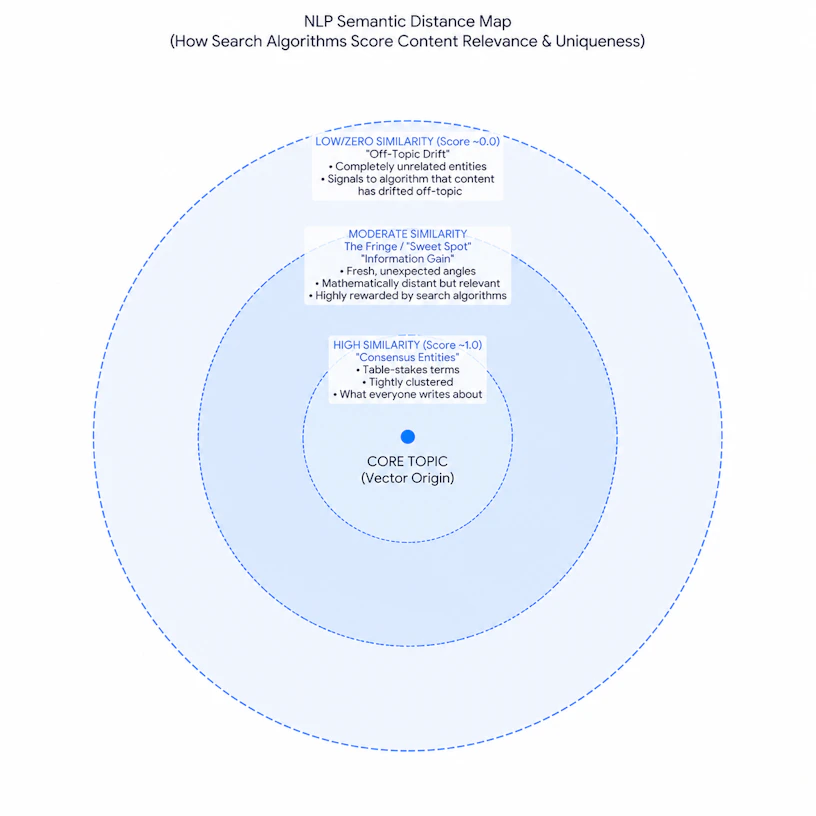
“Covering only consensus entities makes your content a commodity. To signal true information gain to an algorithm, you must cross the boundary into the fringe – without falling into unrelated territory.”

Why is information gain important?
With generative AI making it effortless to churn out baseline content, Google is aggressively tweaking its systems to reward pages that add new information rather than just rewording or curating what already exists. High information gain is critical because it:
- Builds topical authority – proving you have unique insights that position your brand as an industry leader.
- Secures AI Overview visibility – as informational content from sources that offer unique data points or expert analysis is heavily favoured by Google’s AI Overviews.
- Future-proofs rankings – because content built on original research cannot be easily replicated by AI models or competitors.
Does Google use information gain in its algorithm?
Yes, and its footprint is visible across recent algorithm updates. Notably, Google’s March Core Update heavily targeted low-effort, unoriginal content, signalling a permanent shift toward information uniqueness.
Google’s latest official guidance encourages creators to provide unique viewpoints:
| “Providing a unique point of view: Our AI systems take a look at a variety of sources, so it can be helpful to have a unique viewpoint that stands out. For example, a first-hand review provides a unique perspective based on personal experience, whereas a summary of existing content simply restates information already available elsewhere. Create the content yourself based on what you know about the topic, and consider what in-depth experience you can bring to your content. Don’t just recycle what others on the internet have already said, or could easily be produced by a generative AI model.” |
What are the best tactics to demonstrate information gain in my content?
To build an SEO strategy that avoids the echo chamber effect, you must utilise unique ‘information nuggets’ in your content pipeline. Here are some ways to execute this:
Conduct and publish original research
Running custom industry surveys, analysing internal proprietary data or building original case studies will produce new data that search engines haven’t crawled before.
| B2C Example | B2B Example |
|---|---|
| Instead of relying on generic ‘best paint colour’ lists, a home decor brand conducted a survey of 1,000 homeowners on their mood and productivity levels in different room colours. Publishing this specific ‘home-productivity’ index provided proprietary data that interior design blogs could cite, effectively outperforming stock-standard guides and earning high-quality backlinks. | To address the generic ‘state of remote work’ articles, a project management software company analysed its own anonymised data from 50,000+ global accounts to uncover the actual decline in ‘deep work’ hours per week. By visualising this internal data as an interactive dashboard, they became the primary source for industry journalists, bypassing standard AI-generated summaries. |
Share first-hand, real-world expertise
Interview internal subject matter experts, feature quotes from industry professionals or describe your own proprietary methodologies and real-world testing results. This real experience can’t be simulated by an LLM.
| B2C Example | B2B Example |
|---|---|
| A boutique activewear retailer stopped simply listing ‘benefits of yoga mats’ and instead published a series of ‘stress-test’ videos featuring professional yoga instructors reviewing their mats after 100+ hours of intense hot yoga sessions. By detailing the wear patterns and specific grip failures, they offered product expertise that built immediate trust with potential buyers and is too difficult for an AI to factually replicate. | An accounting firm replaced generic ‘how to file tax returns’ guides with a ‘Field Notes from the Audit Trail’ series. By having senior partners write about the specific, complex issues clients faced during recent tax audits (and exactly how they resolved them) the firm provided a level of specific, practical advice that generic SEO content lacked, directly satisfying queries from business owners looking for expert validation. |
Implement content audits focused on originality
When updating old content, don’t just add keywords. Audit your content against current SERPs to identify what everyone else is saying and deliberately write sections that cover what they missed.
| Element | Traditional SEO Approach | Information Gain Approach |
|---|---|---|
| Data & stats | Cites publicly available studies, summarises existing industry reports. | Leverages proprietary internal data, custom surveys or unique analysis. |
| Expertise | Relies on generalist knowledge, synthesises information from other blogs. | Features first-hand insights, ‘field notes,’ and quotes from internal subject matter experts. |
| Angle & strategy | Mirrors the ‘consensus’ coverage of top-ranking SERP competitors. | Disrupts the consensus by exploring ‘fringe’ sub-topics and providing counter-narratives. |
| Content goal | Achieve ‘comprehensiveness’ by covering everything competitors cover. | Achieve ‘uniqueness’ by adding value that cannot be easily replicated. |
Design unique visuals, diagrams and tools
Create custom infographics, diagrams or embed free interactive tools. Search engines process these elements as high-value, unique assets that will enrich a user’s search journey.
Using AI to help speed up the process of finding unique content angles
In addition to manual exploration, it can be helpful to use an AI to speed things up and uncover opportunities you may have missed. By using a prompt such as the one below, you force the AI to act as a diagnostic tool rather than a generation tool.
Instead of asking the AI to ‘write a post about X’ (which often leads to regurgitation), you are asking it to act as a content-gap auditor. This workflow ensures you start your drafting process by knowing exactly where the competition is failing to provide unique value, allowing you to build content that immediately offers higher information gain than every other result on page one.
# Role: Expert SEO Content Strategist

## Task:
Analyse the provided SERP context to identify "consensus" content and uncover high-value "information gaps."

## Input:
1. Target Keyword: [INSERT KEYWORD HERE]
2. Top Ranking URLs / Text Content: [PASTE TOP 5 RANKING URLS HERE]

## Instructions:
Step 1: "The Consensus Review"
- Analyse the input text.
- List the recurring points, definitions, and arguments that are present in at least 4 of the 5 results. This represents the "consensus."
- Define this clearly so we know exactly what we are trying to *avoid* repeating.

Step 2: "The Gap Analysis"
- Look for what is missing. Identify specific perspectives, data types, expert anecdotes, or logical counter-arguments that are NOT covered by the consensus.
- Search for "Fringe Entities"—related concepts or sub-topics that the top-ranking pages touch on but fail to explore in depth.

Step 3: "The Strategy Output"
- Propose 3 unique content "nuggets" that would provide high information gain.
- For each nugget, explain:
  - Why it is unique (what consensus it disrupts).
  - How it provides "real-world" value (data, expert insight, or tool-based utility).
  - A proposed H2/H3 heading for this new section.
How does information gain improve organic search performance?
By shifting from commodity content to unique value creation, you directly influence the signals Google’s algorithms use to determine quality and authority. The tactics discussed above improve performance by making your site an essential destination for search engines and users alike.
Why information gain drives performance
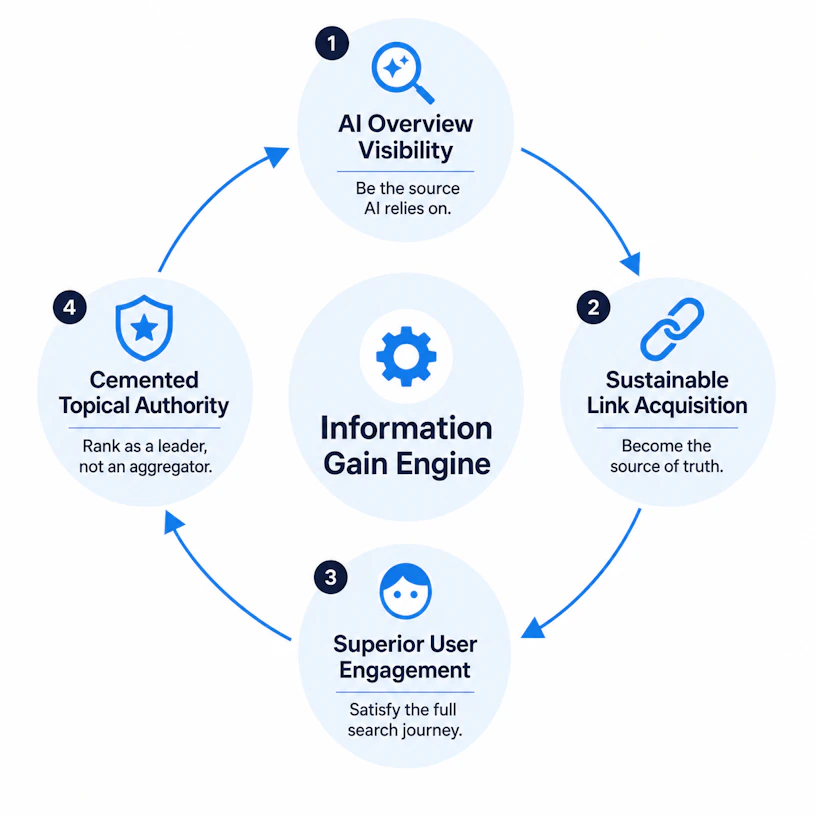
- Higher visibility in AI Overviews
By integrating proprietary data and specific expert insights, your content becomes the ‘source’ that Google’s AI models prioritise. When your page offers the unique data points that AI needs to synthesise accurate answers, you significantly increase your chances of securing citations in AI Overviews. - Sustainable link acquisition
Original data, exclusive expert opinions and proprietary methodologies turn your site into a ‘one source of truth.’ Publishers and industry journalists are far more likely to link to a primary source of data than to a rehashed summary, fuelling your organic backlink profile. - Superior user engagement
High-value, fresh content lowers bounce rates and increases time-on-page. When your content provides the ‘nuggets’ of information users can’t find elsewhere, you generate positive UX signals that demonstrate to Google that your page effectively satisfies the user’s full search journey. - Cemented topical authority
Information gain is the engine of topical authority. By consistently contributing unique viewpoints rather than regurgitating common knowledge, you signal to Google that your domain possesses depth and expertise. This holistic approach makes it easier for your entire site to rank, as you establish a reputation as a leader rather than an aggregator.
Ensuring good Information Gain ROI
Information ROI = Information Gain (Value) – Information Cost (Effort).
Even if your content is packed with unique insights and proprietary data, if it is trapped within a massive, poorly formatted wall of text, the “information cost” becomes too high. When the effort to find the answer exceeds the perceived value, the user bounces, signalling to Google that your page failed to resolve their query – regardless of how unique your content is.
Keep the following in mind:
- Visual scannability: Avoid walls of text. Break complex insights into bite-sized chunks using bullet points, bolding for key takeaways, frequent, descriptive H3 subheadings and adding jumplinks to the top of your content. If a user can’t grasp the value of your insight within five seconds of scanning, the interaction cost is too high.
- Interactive progressive disclosure: Use accordions, tooltips or tabbed interfaces to organise dense data. This allows users to forage for the specific data points they need without overwhelming them with information that isn’t relevant to their immediate intent.
- Visual anchors: Replace paragraph-heavy explanations with custom diagrams, callout boxes, or infographics. A well-designed visual anchor functions as a shortcut, allowing users to extract complex information gain in a single glance rather than reading hundreds of words.
- Strategic white space: Don’t crowd your unique insights. Use white space to isolate high-value data points. This creates a visual hierarchy that guides the user’s eye directly to the unique information gain, significantly reducing the cognitive load required to process your content.
How to measure the impact of information gain on SEO
To measure information gain, you have to look at indirect clues. By combining GSC data (what Google thinks your page is about) with GA4 data (how users actually behave), you can accurately audit and measure your impact.
1. Total query expansion (GSC)
If your information gain update worked, your page will become relevant to a broader web of topics.
What to look for: Look at the total number of unique queries triggering impressions for that URL. If that number goes up, Google recognises that your content now provides new, unique angles.
2. Referral traffic (GA4)
While many AI-driven search journeys don’t result in an immediate click, it is still vital to measure referral traffic in GA4 to see how often your brand is being cited.
Using the new AI Assistant channel in Google Analytics 4 allows you to connect your information-gain strategy directly to concrete, real-world metrics, proving the commercial value of your high-quality content.
3. Average engagement time (GA4)
While GSC can’t see what happens on your site, Google Analytics 4 can.
What to look for: Check the Average Engagement Time for that specific URL. If users are finding unique “nuggets” of information they couldn’t find elsewhere, this number will likely increase. If it is under 10–15 seconds, they are leaving immediately.
4. Internal click-through rate (GA4)
The ultimate sign of a solved search journey is that the user stops searching Google and starts navigating your site instead.
What to look for: Track whether the update leads to more clicks on your internal links, newsletter sign-ups, or next-step pages.
Mastering information gain is essential to breaking free from commodity SEO and building lasting search authority in an AI-driven landscape. If you’re ready to elevate your content strategy with unique, high-value insights that rank, get in touch with our team today.