
As artificial intelligence transitions from information retrieval to autonomous task execution, the underlying infrastructure supporting ecommerce is undergoing a fundamental architectural shift.
The Universal Commerce Protocol (“UCP”) provides the unified communication layer required for AI agents to browse, negotiate, and execute transactions directly across merchant back-ends such as payment gateways. It’s an open-source standard co-developed by Google alongside enterprise retail, technology, and payment providers.
For performance and search marketers, WebMCP and UCP completely redefine how people browse and buy online. WebMCP helps AI navigate your web pages, while UCP completes the conversion. Below, we break down how the technology functions, current rollout timelines, key trade-offs, and what enterprise brands need to do to prepare their marketing data.
- The shift to Agentic Commerce & GEO
- What is Universal Commerce Protocol ("UCP")?
- Global rollout & Geographic landscape (July 2026 status)
- United States Market Maturity
- United Kingdom Market Expansion
- European Union ("EU") Landscape
- Technical Architecture: How UCP operates behind the scenes
- How to register UCP capabilities on your website
- Trading off brand experience for conversion velocity
- Frequently Asked Questions
- Is UCP exclusive to Google Search and Gemini?
- What is the current rollout timeline for UK and European merchants?
- How do we offset the loss of on-site brand experience when adopting UCP?
- Who acts as the Merchant of Record ("MoR") during a UCP transaction?
- How do performance marketers measure ROAS on agentic zero-click conversions?

The shift to Agentic Commerce & GEO
Over 58% of digital shopping journeys now start inside conversational AI tools, yet actual purchases within these interfaces regularly stall. The issue isn’t interest; it’s friction. Today, when shoppers ask an AI to find or compare products, traditional websites force them out of the chat and onto an external browser tab to finish buying, a jarring transition that kills momentum right at checkout.
MCP eliminates this drop-off. By connecting AI agents directly to a website’s underlying tools, MCP allows shoppers to research, configure, and purchase complex product bundles without ever leaving the conversation.
This evolution of LLM discovery has given rise to Generative Engine Optimisation (“GEO”). Where traditional Search Engine Optimisation (“SEO”) focused on indexing keywords, acquiring backlinks, and driving web traffic to owned landing pages, GEO focuses on structured data accessibility, algorithmic trust, and (soon, we expect) transactional readiness within AI synthesis engines.
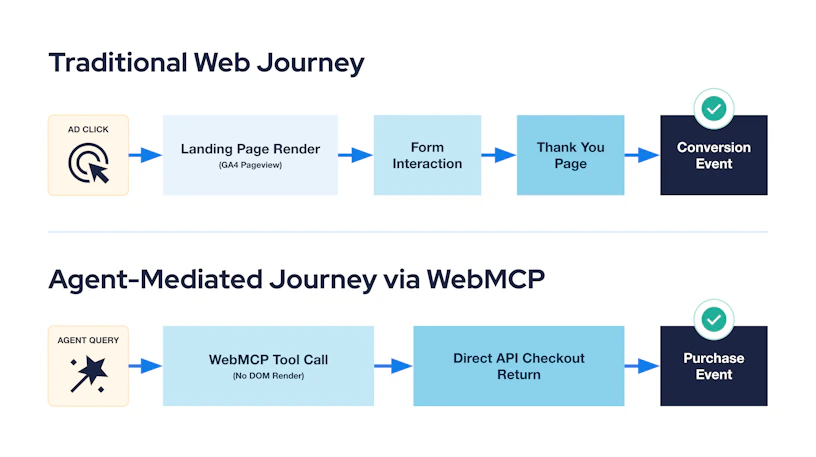
UCP acts as the structural bridge between brand discovery inside conversational environments and the actual possibility of sales transactions.
What is Universal Commerce Protocol (“UCP”)?
Universal Commerce Protocol (“UCP”) is an open-source, vendor-agnostic communication standard designed to establish a shared digital language between consumer-facing AI surfaces (such as Google Search AI Mode, the Gemini app, or third-party assistants) and merchant commerce platforms.
Co-developed by Google in partnership with major enterprise retailers (including Shopify, Etsy, Wayfair, Target, and Walmart) and governed by an expanded Tech Council including Amazon, Meta, Microsoft, Salesforce, and Stripe, UCP provides a universal digital standard for transactions across competing platforms.
This eliminates the need for bespoke, one-to-one Application Programming Interface (“API”) integrations between every AI model and every individual merchant platform.
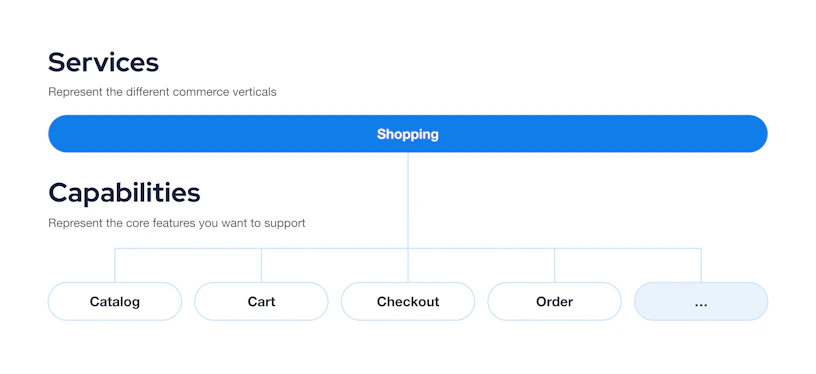
Key features of the protocol include:
- Retailers own the data: Retailers retain direct ownership of the customer relationship, pricing rules, and fulfilment. UCP provides the universal rules for how systems connect, without taking a cut of the transaction or acting as a store itself. The shopper talks to the AI, but the merchant stays in complete control. Every transaction, order detail, and data point still flows straight through the retailer’s backend tools.
- Payments direct to merchant gateways: UCP handles the data, allowing merchants to plug in existing payment processors via payment handlers without exposing raw financial credentials to AI agents.
- Capabilities are modular (and growing): The protocol structures interactions into modular capabilities that merchants can enable incrementally depending on their infrastructure maturity.
UCP was initially set to expand to cover:
- Identity recognition and loyalty modules/support
- Expansion beyond retail towards hospitality (menus, delivery notes, tipping, etc)
- Expansion towards accommodation (bookings, scheduling, etc)
- Wider agentic capabilities, and more
Global rollout & Geographic landscape (July 2026 status)
As of July 2026, the rollout of UCP has transitioned from initial pilot testing to active multi-region deployment across distinct global markets:
United States Market Maturity
In the US market, UCP-powered agentic checkout is operating live across major enterprise retailers including Walmart, Target, Etsy, Wayfair, and Shopify merchants. Search users on Google Search AI Mode, and the Gemini app can evaluate product bundles and execute transactions without leaving the AI conversation.
United Kingdom Market Expansion
Following announcements at Google Marketing Live 2026, the UK rollout is progressing through a phased release across mid-2026. Performance marketers in the UK are currently optimising Google Merchant Centre feeds with native_commerce tags and publishing domain manifest files (/.well-known/ucp) to capture early-adopter inventory signals ahead of full public rollout.
European Union (“EU”) Landscape
In Europe, adoption is governed by localised privacy and regulatory frameworks. Compliance with the General Data Protection Regulation (“GDPR”), ePrivacy Directive, and Digital Markets Act (“DMA”) requires explicit consent verification before user identity tokens or purchase histories are exchanged between AI surfaces and merchant backends. European commerce leaders are prioritising UCP’s Embedded Checkout primitive, which renders merchant-controlled web components inside AI interfaces, maintaining strict regulatory compliance and consent logging.
Technical Architecture: How UCP operates behind the scenes
To understand UCP execution, systems engineers and performance marketers must evaluate its core functional capabilities. The protocol divides the commerce lifecycle into (currently) five discrete topics:
- Product Discovery: Exposes real-time stock levels, dynamic pricing, localised availability, and product attributes directly to the AI agent.
- Cart Management: Standardises multi-item orchestration. The AI agent can append items, apply promotional codes, calculate local taxes, and evaluate delivery rules within a single conversational session.
- Identity & Loyalty linking: Enables secure profile binding between the AI environment and the merchant’s Customer Data Platform (“CDP”) or Customer Relationship Management (“CRM”) system. This ensures member-only pricing, targeted rewards, and personalised delivery preferences apply automatically.
- Checkout Orchestration: Provides two distinct integration paths:
- Native Checkout: The consumer UI surface presents a native, streamlined payment component while passing tokenised credentials back to the merchant for execution.
- Embedded Checkout: Allows the merchant to render a custom, secure web component inside the agent UI, ensuring strict brand control over the final confirmation stage.
- Order Management & Post-Purchase: Exposes structured endpoints for status retrieval, shipment tracking, and self-service returns processing through the agent conversation.
UCP product discovery could overlap with WebMCP depending on your configuration, but UCP should be your priority here if you’re adopting UCP through checkout experiences.
How to register UCP capabilities on your website
For an AI agent to interact with a retail backend, it must first discover what UCP endpoints and capabilities the merchant supports via a standardised manifest file hosted at: ‘https://example-merchant.com/.well-known/ucp’
This JSON payload declares supported capabilities, protocol versions, authentication requirements, and payment handler definitions, allowing AI crawlers and agents to map system capabilities dynamically.
Trading off brand experience for conversion velocity
Adopting UCP represents a deliberate commercial trade-off. By allowing AI agents to complete purchases directly within search and conversational surfaces, merchants willingly surrender direct control over on-site experience: visual merchandising, interactive landing pages, and cross-sell messaging.
For performance-minded marketing and technology leaders, evaluating this trade-off requires balancing brand experience losses against measurable conversion efficiencies:
| What you surrender | What you gain |
|---|---|
| Custom landing page visual storytelling On-site pop-up banners & upsell widgets Direct control over traditional UI UX Session duration & site pageviews | Zero-friction, zero-click conversion Priority recommendation in AI Search Lower Customer Acquisition Cost (“CAC”) Real-time inventory & price trust |
When a business makes the strategic choice to adopt UCP, there must be alignment on three core realities:
- Off-site commerce: Transactional execution shifts away from your website and your direct control, towards multiple destinations which you can only influence.
- Data feed as the storefront: Conversion Rate Optimisation (“CRO”) shifts from testing button colours and hero banners to optimising data feed richness, attribute completeness, GTIN accuracy, and stock reliability. This isn’t actually a million miles away from where we also see some elements of PPC shifting, too, with the advent of more automated campaign types. Managing inputs is key.
- Building brand equity via UCP features: To offset lost storefront interactions, merchants must leverage UCP’s Identity Linking and Embedded Checkout capabilities to pass brand rewards, custom packaging choices, and loyalty benefits directly into the AI agent’s checkout confirmation screen, and to also follow up with customers afterwards.
Frequently Asked Questions
Is UCP exclusive to Google Search and Gemini?
No. While Google authored the initial reference implementation, UCP is an open-source, vendor-agnostic specification governed by a Tech Council that includes Amazon, Meta, Microsoft, Salesforce, and Stripe. Any AI platform, assistant, or e-commerce vendor can build natively against the standard, alongside complementary AI standards/protocols you may have already heard of, like WebMCP and A2A.
What is the current rollout timeline for UK and European merchants?
As of July 2026, UCP agentic checkout is actively deployed across major US retailers. The UK rollout is progressing through phased commercial deployments in mid-2026, while European Union integration is following a technical readiness path centred around GDPR and DMA compliance. However, our opinion on this is that this is the direction of travel, and even with some regulatory amends if necessary, this type of experience is coming, and so feature adoption should really be on your roadmap now.
How do we offset the loss of on-site brand experience when adopting UCP?
Merchants can maintain brand differentiation by using UCP’s Embedded Checkout primitive to render custom web components inside the AI interface, and by configuring Identity Linking to deliver personalised loyalty rewards, member pricing, and tailored packaging options during agent interactions. Outside of the browsing and checkout experience, regular customers will still be exposed to email, mobile/push, and ads, so these need to be working extra hard as some elements of the customer journey become somewhat commoditised.
Who acts as the Merchant of Record (“MoR”) during a UCP transaction?
The participating retailer remains the Merchant of Record (“MoR”) for all purchases processed through UCP. The merchant collects payment through their chosen payment gateway, handles fulfilment, issues legal invoices, manages tax calculations, and maintains the direct customer relationship and all of the data generated throughout the transactions.
How do performance marketers measure ROAS on agentic zero-click conversions?
Because traditional browser sessions and client-side pixels do not trigger during native agent checkouts, performance teams must implement Server-Side Conversion APIs (“CAPI”) linked directly to UCP transaction IDs, using matched first-party CRM data and geo-holdout tests to verify incrementality. This allows identity resolution against known customers, click IDs and other identifiers after the fact once a purchase has happened via UCP in an agentic/LLM setting. One thing is for sure: attribution will continue to get murky, and incrementality will continue to grow.