- What is ChatGPT?
- How SEO strategies can leverage AI like ChatGPT
- Generating content at scale
- Content ideation
- Categorise keywords by search intent
- How generative intent is redefining the 2026 search journey
- Create schema markup
- How do you report on AI Search?
- Risks of using AI for SEO
- What is the long-term impact of language models on the web search industry?
What is ChatGPT?
ChatGPT is a large language model created by OpenAI that uses artificial intelligence and natural language processing to understand and generate human-like responses to text-based input.
A language model is trained on a corpus or multiple corpora, which is a large set of texts. It’s built on the patterns and structure of the language in the corpora, and this knowledge is then used to make predictions about the likelihood of the next word or sequence of words given the previous context.
Language models can be trained to carry out specific tasks, and there are many different models out there, including:
- GPT-5.4
- Gemini 3.1 Pro
- Claude Opus 4.6
- OpenAI o4-mini
- DeepSeek-R1/V3.2
- Kimi K2 Thinking
Tech giants continue to invest billions into AI research to evolve their language models into autonomous agents. Microsoft’s landmark $10 billion commitment in 2023 accelerated ChatGPT’s integration into the ecosystem, eventually unifying its AI efforts under the Microsoft Copilot brand. This strategy aimed to pivot Bing from a traditional search engine into an “AI-first” companion, successfully growing its share of the desktop search market.
Simultaneously, Google’s collaboration with its DeepMind subsidiary led to the launch and rapid evolution of Gemini (formerly Bard). In a definitive shift to counter its competitors, Google transitioned its core interface to prioritise AI Overviews and the conversational AI Mode. This evolution has fundamentally redefined the search landscape, moving the industry toward a “zero-click” reality where the search engine synthesises information directly for the user.
How SEO strategies can leverage AI like ChatGPT
But how do you use ChatGPT for SEO in 2026? There are a few tips and tricks to help.
Generating content at scale
One of the most exciting applications of ChatGPT is content creation at scale. The tool can respond to a wide number of requests to produce both short and long-form copy at scale, potentially reducing hundreds of hours in copywriting time.
ChatGPT can help SEOs to craft metadata, write blog outlines and make category and product page recommendations. Human intervention is essential, however, and SEOs must establish a proofing stage at the beginning, middle and end of the copywriting process to create content that reads naturally while also being keyword-targeted and distinct from competitor content.
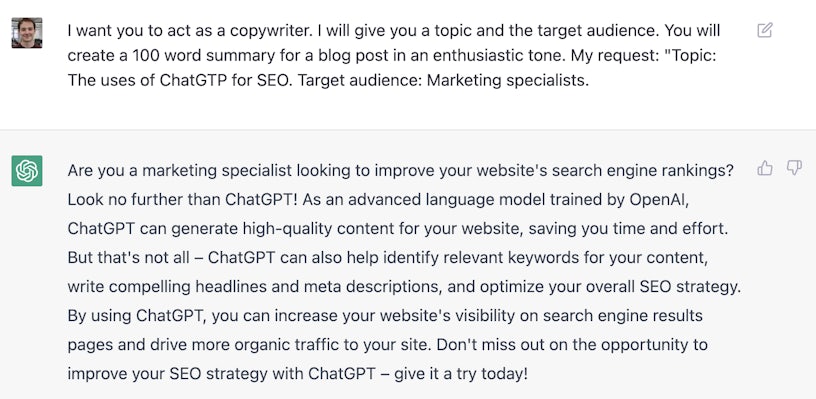
A general rule of thumb for generating a prompt is to use the following format:
- “I want you to act as a….” (copywriter)
- “I will…” (what information will you provide?)
- “You will…” (what do you want it to produce? What is the style or tone you want it to use?)
- Provide your request. Make sure it includes the context you laid out earlier in the prompt.
This process of generating prompts such as these is what is known as prompt engineering. Repeating this style of input will help to train the model over time.
Content ideation
Another use of ChatGPT is for content ideation. Researching topics can be time-consuming and demotivating, but language models facilitate this process. Though the data provided by ChatGPT isn’t as exhaustive or up-to-date as tools like Ahrefs or Semrush, it can be a great jumping-off point for creating a content calendar.
Prominent SEO Gael Breton has shared some valuable prompts for ideation:
“I run a website about X. What are some sub-niches I should be tackling with my content? Give me the results as a table with the sub-niche a number between 1 and 100 to indicate the sub-niche popularity.”

Gael also explains that you can expand on this list and provide a list of target keywords that you can then cross-reference with data from Ahrefs or Semrush.

Due to inclinations in which language models tend to behaviour to sometimes make things up, popularity numbers or requests for numerical data might not be accurate, this is also known as hallucinations.
Categorise keywords by search intent
A common step in the keyword research process is categorising keywords by search intent. Before optimising for keywords, SEOs must first understand where the queries fit into the search journey. Most search terms can be assigned to one of these four types of intent:
- Informational
- Navigational
- Commercial Investigation
- Transactional
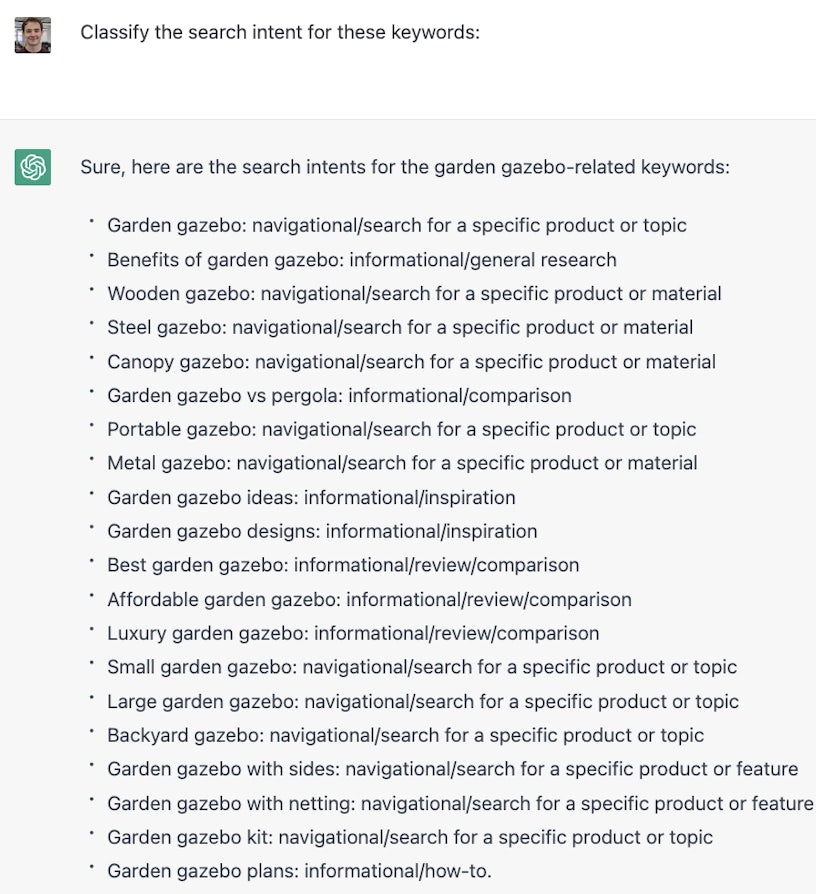
You can ask ChatGPT to classify your list of keywords by search intent, helping you to understand where they fit into the search journey and plan your optimisation efforts accordingly.
How generative intent is redefining the 2026 search journey
Generative intent is an evolution of search intent. It is an emerging area where the definition is not yet clear or universally agreed upon. Whilst traditional search seeks to retrieve and rank information, generative intent seeks a personalised response. Here, in AI-driven environments like AI Mode in Google, or in ChatGPT, users are crafting complex prompts with multiple clauses, containing more information than they would in traditional search, with the intent to generate a personalised answer. The user may be looking to complete a task or summarise a lot of information in one fell swoop.
While traditional keyword data is limited here, new AI Visibility Trackers and Citation Analytics tools are now helping marketers monitor how often their brand is mentioned or cited within these generative responses.
Create schema markup
SEOs can also leverage ChatGPT to create schema markup. Structured data can be used to enhance rich results and by using ChatGPT you can easily go ahead and create templates to work from:

While you still have to edit this it gives a great (and more importantly valid) jumping-off point to start creating structured data for your website.
How do you report on AI Search?
My colleague has written a CMO’s guide to AI search metrics. Here, you’ll learn about the metrics that matter and how to craft a narrative around search that uses LLMs.
Risks of using AI for SEO
Though the applications of ChatGPT are both extensive and exciting, it is important to be aware of its limitations.
It is advisable to avoid an overreliance on the tool, as language models are only as knowledgeable as their corpora and number of parameters. Language models are known to create ‘hallucinations’, which is when the chatbot provides a convincing but made-up answer to a question.
Whilst AI models are continuously improving, meaning some of the most famously reported hallucinations in the early days of LLMs should not be as prevalent as they once were. Citations with links to authoritative content may grow in importance for thoughtful and diligent users who want to verify the output.
The hallucination phenomenon means that human critical thinking and supervision remain essential, particularly when researching content for Your Money Your Life (YMYL) industries, such as medical or financial advice. Not only could this have a potentially harmful impact on readers, but it could also have a negative impact on website rankings, user experience and brand authority.
There is also the question of originality. As more people start using AI tools for content creation, we run the risk of seeing search results become saturated with almost-duplicate or otherwise unhelpful content.
What is the long-term impact of language models on the web search industry?
The development of language models and the integration of conversational AI into Google and Bing is one of the most significant developments in the history of web search. These tools have the potential to revolutionise how people look for answers to questions and find products/services. For SEOs, learning how to optimise content for ai search is now a critical step in adapting to this change.
Some people, including Gmail creator Paul Buchheit, have claimed that the arrival of conversational AI signals the end of search engine result pages (SERPs) as we know them. The ability of ChatGPT to understand complex questions and give clear, concise answers in a matter of seconds could be a major time-saver for many.
Indeed, the introduction of Featured Snippets in Google’s search results in 2018 highlights that finding quick, straightforward answers to questions is a well-recognised goal for people navigating the web. The buzz surrounding ChatGPT demonstrates that conversational AI tools meet this intent much better than traditional SERPs, and hence the only way forward for Google and Bing is to integrate these tools into search engines to retain this element of web search.
This trend is further underscored by Google’s introduction of AI Overviews in May 2024. Designed to summarise information at the top of search results, these AI-generated insights aim to deliver concise answers to complex topics. Expanded to over 100 countries, AI Overviews demonstrate a clear step forward in meeting the demand for quick, accurate information. However, their rollout has also raised questions about accuracy and transparency, highlighting the ongoing challenge of balancing user convenience with reliability.
However, the jury is still out on whether conversational AI tools could truly replace search engines. Many people do not want one answer from a single source but rather would like to compare and view multiple sources, particularly when their intent is transactional.
Language models are also highly limited by the datasets that they are trained on. According to OpenAI, ChatGPT 5.4 (released March 2026) features deep web research and agentic workflows, allowing it to access real-time information and execute complex professional tasks across various software environments.
A lot of the potential behind language models and their long-term impact on web search is still up for debate. For now, ChatGPT and similar tools can be used as tools to facilitate more ambitious SEO strategies and scale organic growth for businesses.