
Welcome to the latest blog from the Impression Paid Media Team, where we uncover the latest news and trends to help you stay ahead of the curve.
Keep reading to discover:
- Google shifts search to 'Agentic Commerce' with AI Mode
- Meta’s ‘Andromeda’ AI makes creative the only targeting left
- AI ‘Buyers’ Agents’ and the rise of Digital Twinning
- Google Ads 2.12: Scaling creative volume with added brand guardrails
- Reddit’s Shopify integration and DPA format refresh
- GA4 cross-channel budgeting plans unveiled
Google shifts search to ‘Agentic Commerce’ with AI Mode
Kicking things off with the changing face of search, Google is officially moving away from traditional keyword queries toward “Agentic Commerce” with the expansion of AI Mode and Direct Offers. Rolled out to bridge inspiration and action, this update fundamentally changes the search ecosystem by allowing AI assistants to do the comparative shopping for users. Instead of a user clicking through multiple tabs to compare products, Google’s AI Mode surfaces sponsored retail options directly within the conversational interface. To help brands stand out in these critical moments of consideration, Google also introduced Direct Offers, a monetisation experience that lets businesses push tailored, real-time incentives like loyalty benefits or price drops to shoppers exactly when the AI determines they are ready to buy.

What does this mean for you?
This integration essentially removes the traditional, multi-step research phase, allowing advertisers to close sales directly within the search engine’s interface. Accelerating the path to purchase, the time and effort consumers spend bouncing between competitor sites is drastically reduced. However, there is a big risk that this “zero-click” reality leads to a traffic crisis for brands. Over-reliance on Google’s AI to act as the middleman means less direct website traffic, making it harder to build first-party data and forcing brands to rely entirely on feed optimisation to remain visible to the algorithm.
Meta’s ‘Andromeda’ AI makes creative the only targeting left
Over on the social side, Meta has completely overhauled its delivery engine with the “Andromeda” system, signalling the official end of manual audience hacking. This AI-driven pattern recognition engine has made traditional tactics like interest stacking and hyper-niche exclusions obsolete. Instead of advertisers manually selecting who sees their ads, Andromeda relies entirely on the creative assets themselves. Analysing visuals, text and contextual cues to find the right buyers across broad audiences. By processing these creative signals alongside billions of engagement data points, the algorithm predicts user behaviour and automatically allocates spend to the most efficient placements without requiring manual intervention.
What does this mean for you?
This shift essentially removes the technical complexities of media buying, allowing marketers to focus purely on psychology, messaging and high-quality creative output. Accelerating campaign learning phases, brands can now scale much faster by simply feeding the algorithm a diverse mix of hooks and visual styles. However, there is a big risk that this demand for constant creative input outpaces a brand’s production capabilities. Without a high-volume system for testing and iterating on new ad components, campaigns will quickly suffer from creative fatigue, leaving advertisers with no manual targeting levers left to pull when performance drops.
AI ‘Buyers’ Agents’ and the rise of Digital Twinning
Looking at the broader programmatic and search landscape, we are seeing a massive shift toward “Consumer AI” acting as active buyers’ agents. Moving beyond simple generative search, these personal AI assistants are now taking on the role of digital twins for consumers; researching, recommending, and even executing purchases on their behalf. This means that users are increasingly offloading their decision-making to AI, resulting in highly compressed marketing funnels where brand discovery, content consumption and commerce all converge into a single, automated interaction right on the search or social platform.

What does this mean for you?
This evolution essentially removes the human element from the initial stages of the buying journey, requiring brands to completely rethink how they optimise their paid media. The opportunity lies in making sure your data feeds, product information and campaign structures are perfectly formatted to be easily read and selected by AI agents rather than human eyes. However, there is a big risk that traditional performance metrics will become entirely disconnected from reality. As AI-to-AI interactions replace human clicks, brands that stubbornly cling to outdated measurement models like traditional CTRs will lose visibility, struggling to understand why their top-of-funnel traffic has vanished while competitors capture algorithmic recommendations.
Google Ads 2.12: Scaling creative volume with added brand guardrails
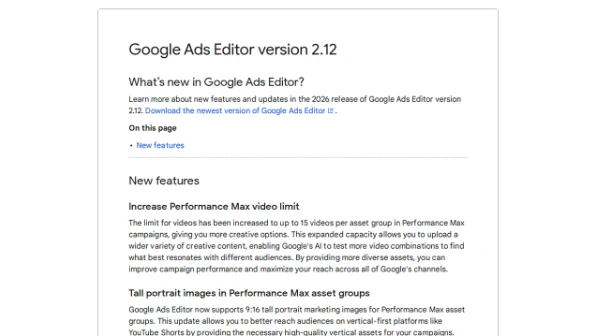
Google released version 2.12 of their Ads Editor in mid-March, which significantly expands the creative ability of Performance Max campaigns. The most notable change is the increased capacity for video assets, upping the limit from 5 to 15 videos per asset group. Additionally, support for 9:16 tall vertical images is now available. The update also introduces new AI text guidelines, allowing up to 25 term exclusions and 40 prompt style messaging restrictions. This helps to ensure AI text generation adheres to specific brand tones and follows messaging guidelines, marking a shift towards sophisticated governance over AI creative output.
What does this mean for you?
This update heightens creative demands, with a 15-video asset capacity now requiring a larger volume of content to be produced in order to maintain competitiveness and avoid any algorithmic fatigue. The official support for 9:16 aspect images highlights increasing mobile-first format demand, aiming for seamless integration of ads to YouTube Shorts, and potential for increased ad performance through the platform. Crucially, the new AI guidelines aim to solve the longstanding ‘hallucination’ risk, sparking hesitation around AI optimisations. Asset count can be scaled with tailored exclusions and restrictions, acting as a safety net to protect your brand identity.
Reddit’s Shopify integration and DPA format refresh
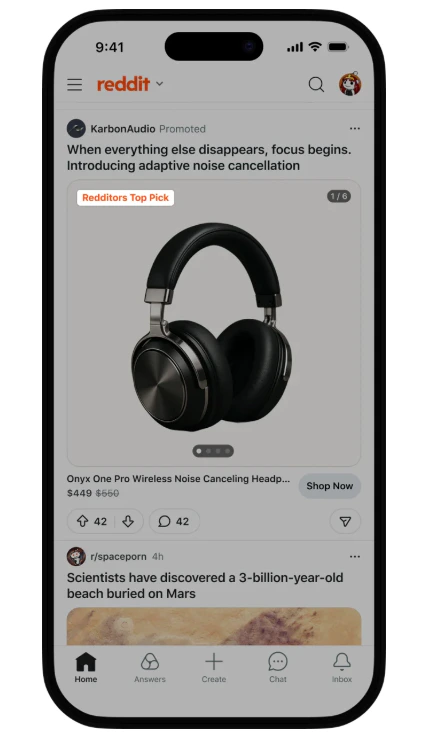
Reddit has announced a major evolution to its Dynamic Product Ad (DPA) offering, headlined by a new Shopify integration, currently in alpha, offering automated catalogue and pixel setup. Alongside this, Reddit launched collection ads, a carousel format pairing a lifestyle ‘hero’ image with shoppable product tiles combining discovery and purchase. Furthermore, community overlays are being tested and will use Reddit’s own data to highlight products resonating with Reddit users, adding native labels such as ‘Redditors Top Pick’ directly onto ad creative.
What does this mean for you?
While historically Reddit has been viewed as a channel for fostering brand awareness, these updates underline its growing status and potential value as a performance channel for your ecommerce, offering access to high-intent consumers during their research phase. If you are partnered with Shopify, Reddit offers seamless onboarding and automatic matching of products to the ideal audience in the correct context. Additionally, Reddit’s native overlays capitalise on the value consumers place on Reddit for research, acting as a direct trust signal to consumers.
GA4 cross-channel budgeting plans unveiled
In a move aiming to shift GA4 from a retrospective reporting tool to a more proactive planning asset, Google has launched cross-channel budgeting (in beta). This update introduces two new features: Projections and Scenario Planner. The first of which enables users to view projected performance for live campaigns against their specific KPI’s. The second, Scenario Planner, aims to model scenario budget allocations across both Google and non-Google platforms, to understand ROI at different levels.
What does this mean for you?
The ability to use Google’s own data analysis to compare budget allocation scenarios seems like a very enticing alternative to current planning methods; however, the eligibility barrier is high, requiring a minimum of one year’s worth of accurate conversion (key events and App conversions are not yet fully supported) and cost data across at least two separate channels. With this reliance on historical data, thorough audits would be required, as any interruptions or inconsistencies could significantly affect Google’s calculations. Rather than viewing this as a standalone solution, it may be best leveraged as a valuable strategic ‘second opinion’ in actual practice.
Look out for our April edition of “What’s New in Paid Media” for a monthly round-up of industry updates to inspire your PPC, Paid Social, and Programmatic strategy. If you want to talk about your business’s aspirations, get in touch!