
Welcome to the latest blog from the Impression Paid Media Team, where we uncover the latest news and trends to help you stay ahead of the curve.
- Google Performance Max finally adds channel prioritisation
- Pinterest turns visual search into a biddable performance channel
- Teen usage restrictions are actively shrinking broad match pools
- Google Ads brings High-Value acquisition to Shopping and deepens retention bidding
- AI review summaries now directly within Google Search ads

Google Performance Max finally adds channel prioritisation
Kicking things off with a major update for PPC, Google has rolled out channel prioritisation and budget caps for Performance Max and Search campaigns as of October 2026. Advertisers can now set grouped networks like the Google Display Network and Search Partners to “High” or “Low” priority, and apply a strict budget allocation. You can even drop that allocation to 0% to completely pause spend on historically wasteful placements. This gives media buyers the ability to steer Performance Max away from low-quality Display inventory without sacrificing the core Search and YouTube conversions that drive the campaign.
What does this mean for you?
This update removes the “black box” frustration that has plagued Performance Max since its launch, allowing you to regain control over where your budget flows. By capping lower-priority networks, the time and money previously wasted on accidental Display clicks is effectively gone, accelerating your return on ad spend. However, there is a big risk that overly aggressive budget caps could lead to a volume crisis for brands. Over-reliance on strict network exclusions can choke off the top-of-funnel discovery that feeds your core search campaigns, leaving you with higher CPA costs as the algorithm struggles to find cheaper, early-stage conversions.
Pinterest turns visual search into a biddable performance channel
Moving over to the social and programmatic side, Pinterest announced a major shift with the launch of Visual Search Ads. Rolling out globally in beta this October, this new format allows brands to buy biddable placements directly within visual search results and “Pin closeups”. Rather than bidding on traditional text keywords, advertisers can now capture shoppers based on visual similarity. For example, if a user zooms in on a specific armchair in a living room photo, a furniture retailer can serve an ad for a visually comparable product exactly at that moment of high-intent comparison

What does this mean for you?
This integration essentially removes the friction from the traditional discovery phase, allowing brands to capture shoppers who know exactly what they want visually, but don’t know the specific brand name or search term yet. Accelerating new customer acquisition, the time spent trying to rank for highly competitive text queries is drastically reduced. However, there is a big risk that this pivot to visual parity leads to a branding crisis for premium retailers. Over-reliance on purely visual matching means your products will be displayed directly alongside cheaper lookalikes, stripping away your brand equity and forcing you into a price war unless your creative imagery is exceptional.
Teen usage restrictions are actively shrinking broad match pools
Wrapping up with a significant shift in audience availability, recent regulatory action, including a historic Meta settlement, are enforcing strict limitations on how young users interact with social platforms. Meta has agreed to mandate default daily usage limits of two hours for teens, a block on apps between midnight and 6 a.m., and muted notifications during school hours. While Meta is pushing for competitors like TikTok and YouTube to adopt similar safeguards, these hard caps on screen time are fundamentally shrinking the active inventory of Gen Z audiences available to advertisers on a daily basis.
What does this mean for you?
This shift removes a massive chunk of cheap, top-of-funnel impressions from the programmatic and paid social ecosystem, forcing advertisers to rethink how they reach younger demographics. Accelerating the need for highly engaging creative, the luxury of relying on endless, passive doomscrolling to pad your reach metrics is effectively gone. However, there is a big risk that this sudden inventory squeeze leads to an immediate cost crisis for brands targeting Gen Z. As the available pool of daily screen time shrinks, competition for those remaining active hours will spike, driving up CPMs and breaking historical benchmarks for broad-audience Advantage+ and standard social campaigns.
Google Ads brings High-Value acquisition to Shopping and deepens retention bidding
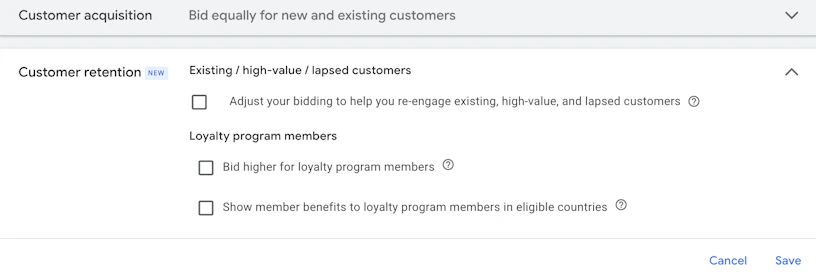
Expanding its automated bidding capabilities for e-commerce, Google has rolled out High-Value acquisition modes to Shopping campaigns while expanding customer retention controls across Search, Shopping, and Performance Max as of October 2026. Building on the unified Customer Lifecycle Optimisation hub introduced earlier in the year, advertisers can now deploy value-based bidding in standard Shopping to bid more aggressively on new shoppers who mirror their most profitable existing customers.
Simultaneously, Google has expanded three granular retention settings across all core retail campaign types: Re-engagement (prioritising lapsed customers based on custom replenishment windows), Loyalty (tailoring bids and offers to loyalty/rewards program members), and Retention-only (restricting campaign delivery solely to defined customer lists).
What does this mean for you?
This update removes the blunt-instrument approach of treating every conversion as equal, allowing you to train Smart Bidding on first-party data so your budgets actively favour high lifetime value buyers and high-margin segments. Accelerating your return on ad spend, the ad budget previously wasted on acquiring one-off bargain hunters or unprofitably retargeting recent buyers is significantly curtailed.
However, there is a big risk that poor audience segmentation could lead to an efficiency crisis for retail brands. Over-reliance on top-line order value rather than actual contribution margin, such as feeding Google lists built around high-ticket clearance buyers or applying a generic lapsed time frame across vastly different product life cycles, could cause the algorithm to overpay for low-margin or churn-prone shoppers, driving up acquisition costs while eroding bottom-line profitability.
AI review summaries now directly within Google Search ads
Google has rolled out AI-generated review summaries directly within Search ads as of October 2026. The automated feature aggregates online reviews across the web to create concise ad snippets highlighting positive customer feedback. Currently live for English Search campaigns across the US, UK, Australia, and India, the summaries appear across all standard devices and ad positions on Google.com, excluding sensitive categories like pharmaceuticals. Crucially, Google confirmed that these snippets are strictly positive-only, filtering out negative sentiment entirely to present instant customer endorsements.
What does this mean for you?
This update removes the friction of driving users to third-party sites to establish trust, allowing brands to build immediate social proof before the user clicks. Accelerating ad engagement and qualified clicks, the manual effort previously spent testing review extensions and structured snippets is substantially reduced. However, there is a big risk that this positive-only filter triggers a credibility crisis for brands with operational weaknesses. Over-reliance on automated praise creates an immediate expectation gap if your shipping, support, or product quality is lacking, potentially leading to sharp post-purchase backlash, which could elevate refund rates and customer churn.
Look out for our November edition of “What’s New in Paid Media” for a monthly round-up of industry updates to inspire your PPC, Paid Social, and Programmatic strategy. If you want to talk about your business’s aspirations, get in touch!