The sun’s finally out, but paid media hasn’t slowed down to enjoy it. Here’s what’s been going on while you were meant to be on the beach.
- Reddit upgrades Ads Manager with Split Testing and an AI ad generator
- Introducing Streaming Ads on TikTok
- OpenAI is rapidly maturing ChatGPT's ad platform
- Google Ads Editor Adds AI Max Support to Shopping Campaigns
- Bite-sized updates
- Adelaide Attention Units land in DV360 Custom Bidding
- Google Ads rolls out Video Campaign Groups globally
- Google adds "How this ad was made" transparency panels

Reddit upgrades Ads Manager with Split Testing and an AI ad generator
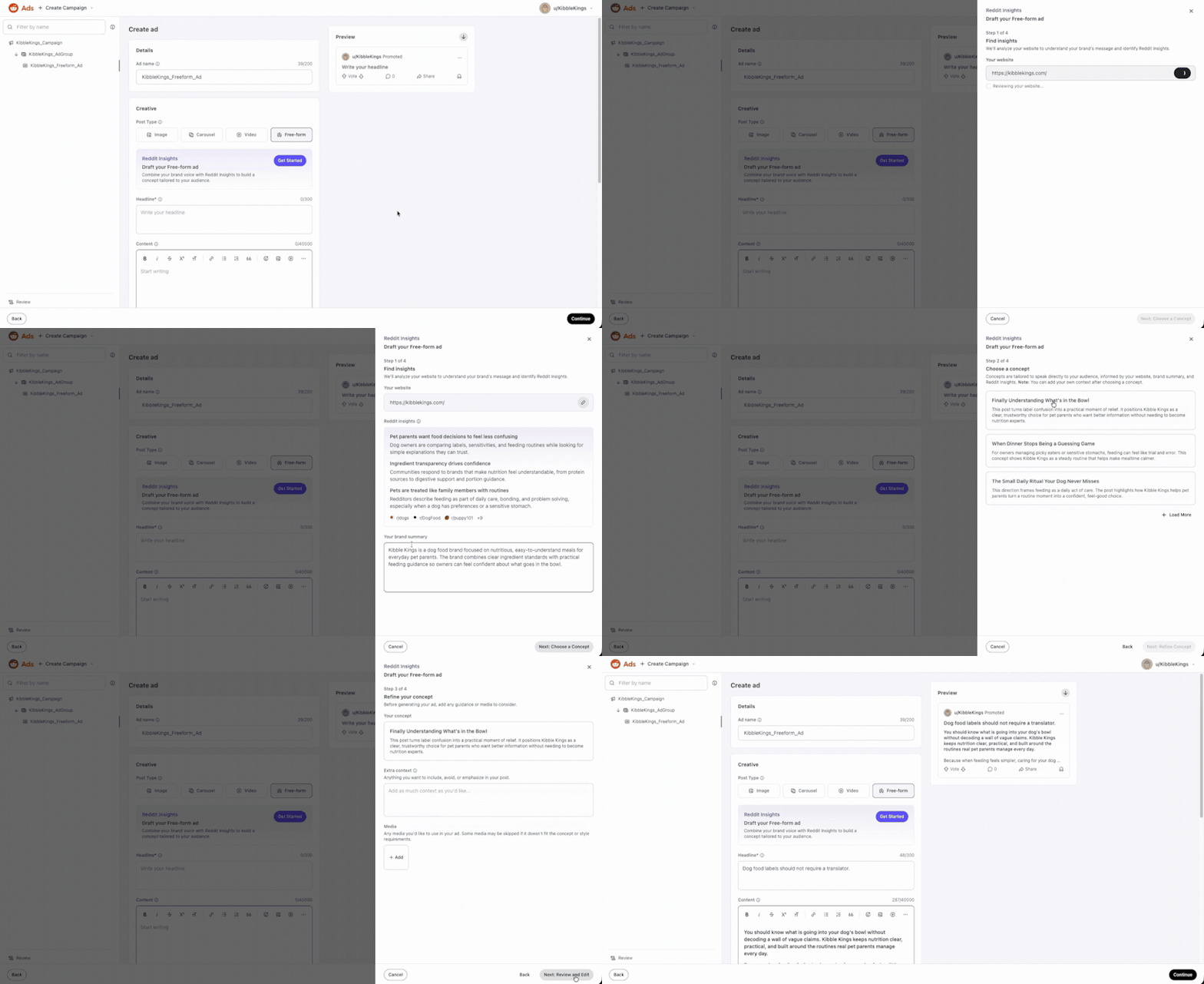
A Free-form Ads Generator is entering beta, which uses Reddit Community Intelligence to scan your website, look at what relevant subreddits are already saying about your brand, and draft a native-feeling ad in the particular conversational tone Reddit demands. On top of that, native Split Testing has launched directly in Ads Manager, allowing advertisers to run proper A/B tests on creatives, placements, or campaign types, including Reddit Max against standard campaigns.

What this means for you
Both of these updates solve something advertisers actually complain about. If you’ve avoided Free-form ads because getting the tone right takes time and a decent copywriter, the generator gives you a solid first draft instantly. Meanwhile, the Split Testing tool means no more guessing or cobbling together workarounds to see what converts. You can now properly test automated targeting against manual community targeting, putting real numbers behind the decision instead of relying on a hunch.
Introducing Streaming Ads on TikTok
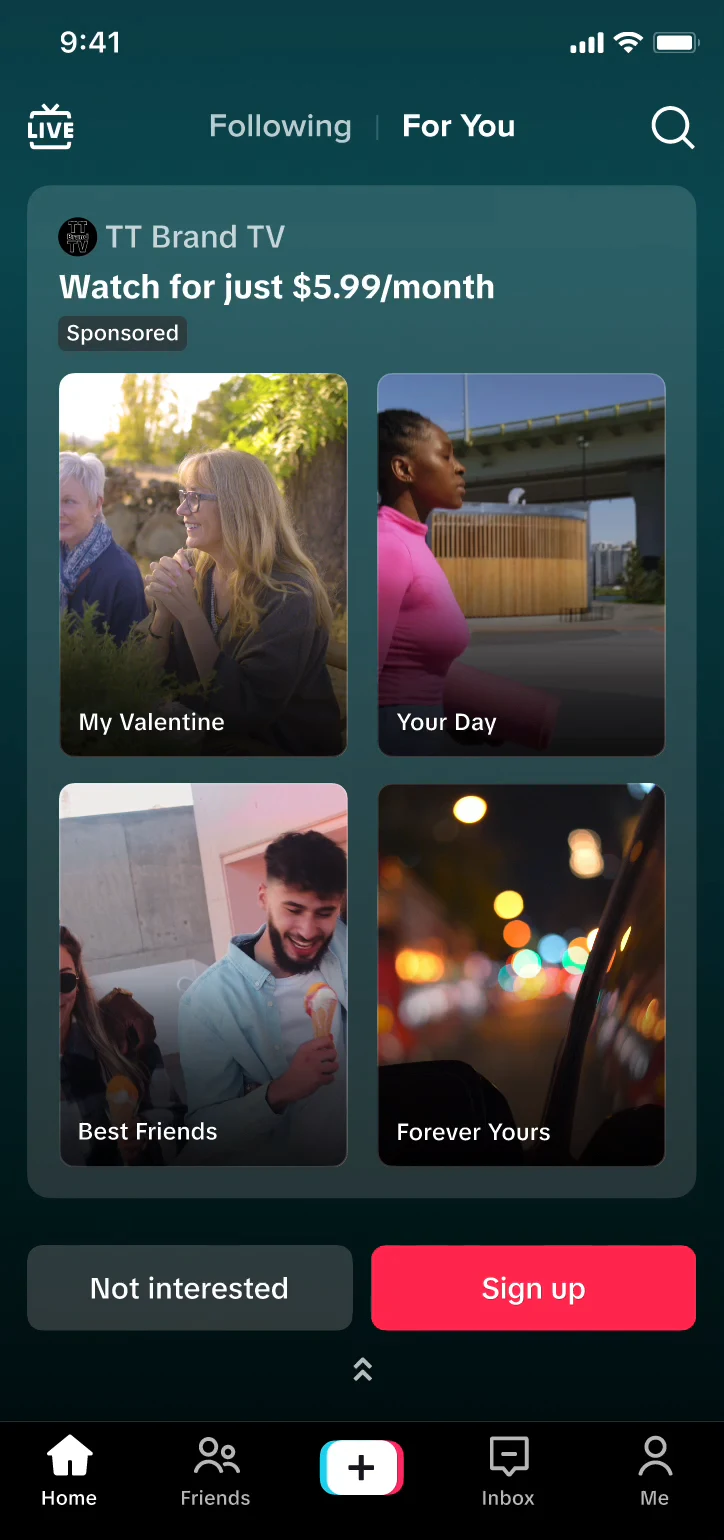
TikTok has officially launched Streaming Ads, a catalogue-driven format built specifically to turn viewers into paying subscribers. TikTok’s automation tool, powered by Smart+, matches a streaming provider’s content library to individual users and predicts which shows or films are most likely to drive sign-ups. This format includes interactive front-end options such as a Multi-Show Experience carousel and auto-scrolling Media Cards, allowing you to showcase multiple titles within a single ad unit. Alongside this, TikTok has also rolled out New Title Launch, a companion tool built for tentpole moments like premieres and live sports that targets high-intent users based on granular signals like genre preference and price sensitivity.
What this means for you
If you work in VOD (Video on Demand), OTT (Over-the-Top), or entertainment releases, this represents a major shift away from standard awareness campaigns and into genuine performance marketing. Instead of cutting bespoke creative for every individual title, Smart+ dynamically builds personalised ads from your existing catalogue automatically. The stat worth remembering here is that TikTok users are 167% more likely to hold onto a subscription just to keep up with the conversation around a show, meaning there is a very real commercial case for making sure your titles show up exactly where that conversation is happening.
OpenAI is rapidly maturing ChatGPT’s ad platform
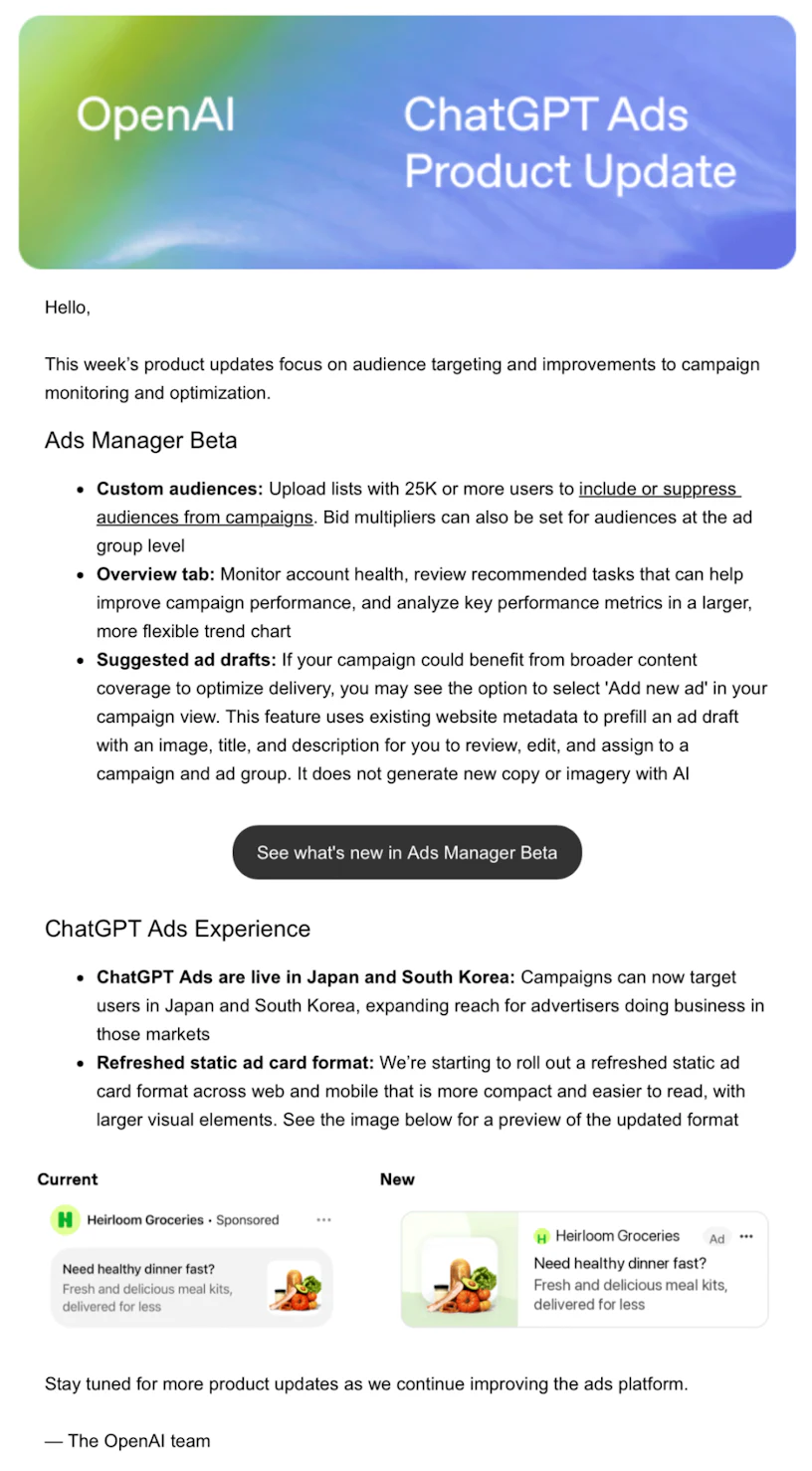
The latest releases include conversion bidding, geo-exclusions, and bulk campaign editing tools, alongside a new Overview tab that finally gives media buyers a proper dashboard to check performance at a glance. Coming so soon after the launch of CPC pricing, it is clear OpenAI is pushing for feature parity with Google Ads and Meta, and they want it fast.
What this means for you
This is the point where ChatGPT ads stop feeling like a lightweight experiment. Conversion bidding allows you to optimise for actual business outcomes, such as leads or purchases, rather than simply paying for clicks. At the same time, geo-exclusions help tighten targeting and reduce wasted spend. The bulk tools and Overview tab might not be flashy, but they are exactly the kind of infrastructure a platform builds when it is preparing for real volume. If the Ads Manager put you off before, it is absolutely worth taking another look now.
Google Ads Editor Adds AI Max Support to Shopping Campaigns
Google has launched version 2.13 of Google Ads Editor, bringing a slate of new features designed to streamline bulk account management offline. The biggest addition is full offline support for AI Max in Shopping campaigns, allowing media buyers to manage automated text generation, URL expansion, brand lists, and exclusions without jumping into the web interface.
Beyond Shopping updates, this release adds Customer Retention Goals for Performance Max, expands Demand Gen placements to Google Maps, and introduces new AI compliance controls for visual assets. Google is also taking steps to retire support for creating new Video Action campaigns within the desktop tool.
What this means for you
If you run paid search or ecommerce campaigns, this is a great reminder to give your product data some extra attention. Because Google’s AI builds these descriptions using your existing details, incomplete feed entries or generic landing page text can result in uninspiring ad copy.
Taking time to audit your Merchant Center fields, ensuring benefits, technical specs, and key selling points are crystal clear, helps protect your brand voice. Be sure to keep a close eye on your Shopping campaign metrics as this test unfolds so you can spot any shifts in performance early.
Bite-sized updates
Adelaide Attention Units land in DV360 Custom Bidding
DV360 is bringing Adelaide’s Attention Units directly into Custom Bidding, either as a ready-made “Maximize Adelaide Attention Unit” algorithm, or as a multiplier in your own bidding scripts.
This is highly useful if you have wanted to bid on actual attention rather than basic viewability, but didn’t want to build a complex scoring model yourself. Simply plug in Adelaide’s benchmark, bid up on high-attention inventory, and stop wasting spend on placements nobody is actually looking at.
Google Ads rolls out Video Campaign Groups globally
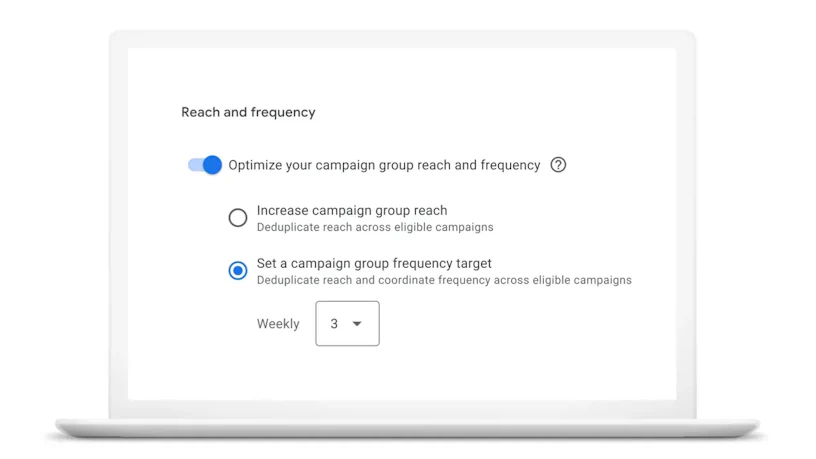
You can now coordinate YouTube reach and frequency across multiple video campaigns at once, setting one overarching target while keeping separate budgets and creatives underneath.
Google’s MMM data points to 2.7 as the optimal weekly frequency, worth a 19% ROI lift (DV360 support is coming soon). Anyone running several YouTube campaigns knows the pain of accidentally hammering the same user across all of them. This feature fixes that problem entirely, while also giving you a single, unified place to check your overall reach and frequency.
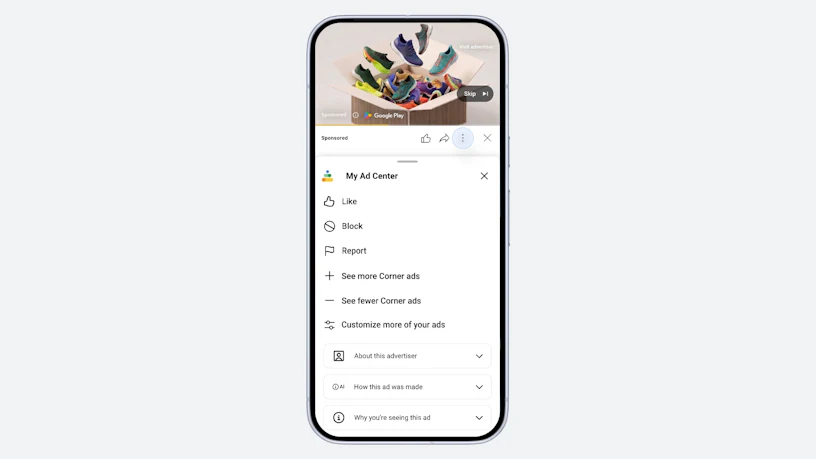
Google adds “How this ad was made” transparency panels
New AI disclosure features are rolling out across Search, YouTube, and Discover. ‘My Ad Center’ will now feature a section flagging when generative AI was used to create or edit an ad.
Google’s own AI tools tag this automatically, while a manual toggle has been introduced for anything made with third-party tools like Midjourney or ChatGPT. If external AI generation is part of your creative workflow, get this toggle built into your deployment process now, as labelling rules are only going to tighten from here.
Look out for our August edition of “What’s New in Paid Media” for a monthly round-up of industry updates to inspire your PPC, Paid Social, and Programmatic strategy. If you want to talk about your business’s aspirations, get in touch!