
In its basic form, push marketing means that you are directly marketing to the customer, by ‘pushing’ your content out to the public. On the other hand, pull marketing focuses on ‘pulling’ traffic to your website or social media pages.
There are suitable times to use both strategies and they can also be used together – the key is knowing when to use each one.
Push marketing definition
Push marketing defines a strategy where businesses aim to push their products in front of consumers, with the overall aim to gain exposure, highlight unique selling points and ultimately make a sale.
Push marketing tends to be a common approach within the fast-moving consumer goods (FMCG) arena, generating higher rates of short-term sales.
When is push marketing useful?
- When launching a new business or a website that is yet to build a reputation
- When releasing brand new products or moving into a new niche
- For promotional campaigns
- For seasonal sales and events such as Spring Sales, Black Friday and Christmas
- To generate quick sales and increase cash-flow
- To help with brand recognition when competing against a dominant competitor
- Launching new brands or products that don’t yet have organic search volume.
- Driving immediate traffic for seasonal events, flash sales, or inventory clearance.
- Staying visible in high-competition niches where customers might otherwise forget you between purchases.
- When using paid media to quickly gather data on new audiences, messaging, or product-market fit.
- Re-engaging users who are stuck in the ‘messy middle’ of their research journey.
One of the most popular ways of executing push marketing is through email marketing and paid media, which can include sponsored posts on social media, pop-ups, display ads, paid search results, video ads and other forms of promoted multimedia.
Paid media can be a fruitful way of expanding your brand reach, getting more clicks, and generating more traffic.
Push marketing example in action
To drive rapid volume for their latest innovation, PlugHugs deployed a high-impact push marketing campaign. Their product, an industry-leading earplug, boasts a dual USP: a 70% increase in retention during sleep and unmatched noise-cancellation capabilities.
Recognising their core demographic as males aged 25–60, PlugHugs utilised paid advertising on social media to target potential customers. By leveraging granular targeting – including age, location, and socio-economic status—they bypassed the need for organic discovery. Instead, they placed their solution directly into the feeds of their target audience, ‘pushing’ users from initial awareness to a website purchase in a single frictionless journey.
Pull marketing definition
On the other hand, pull marketing (or inbound marketing) is focused on offering quality content such as blog posts, articles or videos that a potential customer can access in their own time. The aim with pull marketing is to pull the customer in with an enticing, attractive and helpful offering.
Creating content that encourages a user to click and learn more can help with exposing the user to the brand that has published the content.
When is pull marketing useful?
- When the customer already has an idea of what they are looking for
- To help maintain dominance in a specific industry
- When a customer needs to do more research on a product or service
- When trying to move the customers to the next stage in the conversion journey
- When positioning a brand as the ‘go-to’ expert in a crowded market.
- When providing answers to common objections before the customer even talks to sales.
- When building assets (like SEO or a YouTube channel) that generate traffic without a continuous ad spend.
Customers with specific needs will more than likely start their search for a solution using search engines, which is why using SEO tactics is vital to the success of a pull strategy. Customers who are using search engines to find out the options available to them, are already prepared and ready to take the next steps towards conversion.
Overall, pull marketing is far less interruptive than push marketing and tends to build brand loyalty more effectively.
Pull marketing example in action
AllTrails (a fitness and hiking app) needs to convince people to pay for a ‘Pro’ subscription without annoying them with constant ‘Buy Now’ pop-ups.
AllTrails focuses heavily on User-Generated Content (UGC) and SEO. They don’t just run ads saying ‘Download our app’ – they ensure that whenever someone is planning an outdoor activity, AllTrails is the answer they find.
How the ‘Pull’ Works:
Step 1: A person decides they want to get active and searches: ‘Best dog-friendly hikes near me with a waterfall.’
Step 2: Because AllTrails has thousands of pages optimised for every specific trail, city, and feature (e.g., ‘waterfall,’ ‘kid-friendly,’ ‘steep’), they perform well in both traditional search and are also cited in AI search.
Step 3: The user clicks and gets a free map, photos from other hikers and real-time trail conditions. AllTrails has solved the user’s immediate problem for free.
Step 4: The user is now ‘pulled’ into the ecosystem. They download the app to save the map. Later, when they realise they need offline maps for safety (the paid feature), they upgrade. They aren’t buying because of an ad; they are buying because the tool became essential during their research phase.
How can push and pull marketing work together?
By using push and pull marketing together, you create a marketing ecosystem that both generates demand and captures it. Push marketing creates the trigger, while pull marketing provides the evidence. Together, they ensure that your brand is present at the first point of contact and remains the preferred choice throughout the unpredictable twists and turns of the modern buyer’s journey.
Push marketing remains the primary engine for demand generation. In an era of algorithm-heavy social feeds, push tactics are used to target potential customers who may not yet realise they have a need. The goal here is to spark ‘latent demand’- introducing a solution through highly targeted and optimised ads that reach relevant audiences before they even begin a manual search.
Conversely, pull marketing dominates the discovery and evaluation phases. Today’s consumers are researchers; they use search engines, AI assistants, and social proof to validate their choices. Pull tactics ensure that when a customer is actively seeking a solution or comparing options, your brand is the most authoritative and accessible answer. In 2026, this isn’t just about being found, it’s about providing enough value and social currency to pull the customer through the final stages of the journey, turning interest into long-term brand advocacy.
Push and pull marketing in the era of AI
In the era of AI, the boundary between push and pull marketing has given way to a more fluid, predictive user journey. Push marketing has evolved from broad broadcasting into ‘predictive precision,’ where AI algorithms analyse micro-behaviours to interrupt a user’s feed with the exact solution they need, often before they’ve even realised what they want. Meanwhile, pull marketing has shifted from simple keyword matching to Answer Engine Optimisation. To be ‘pulled’ into a consumer’s world in 2026, a brand must offer deep, human-led authority that AI assistants prioritise as a trusted source.
By integrating these strategies, you navigate the ‘messy middle’ of the modern journey – using AI-driven push tactics to spark demand, while ensuring your pull content provides the expert validation needed when a user asks their AI for a recommendation.
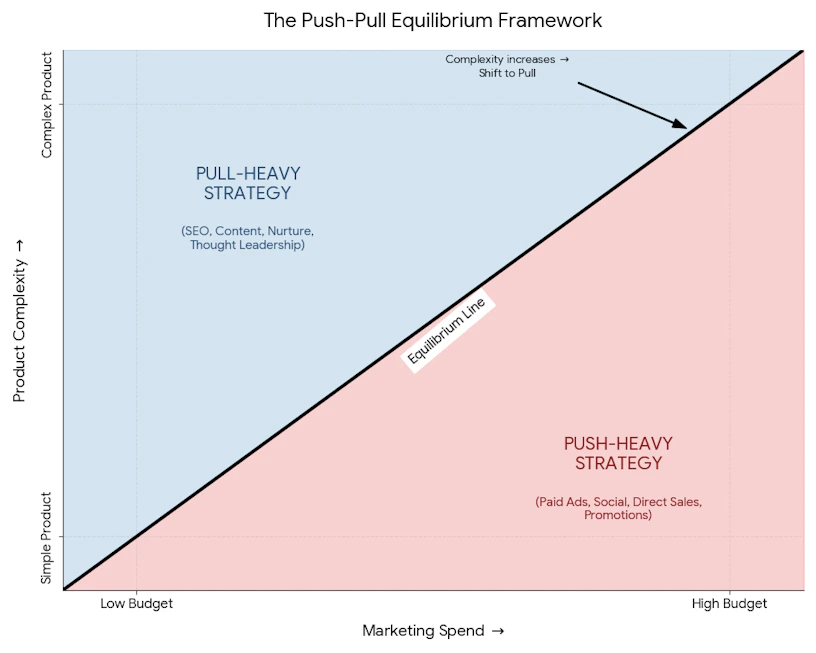
This graph shows that the more complicated your product is, the more you need to ‘pull’ customers in, while the more money you have to spend on simpler products, the more you should ‘push’ them out.
On the vertical axis, you have Product Complexity; as a product gets harder to explain or more expensive, the graph suggests moving toward a Pull-Heavy Strategy like SEO and blogs to educate the customer. On the horizontal axis is Marketing Spend – as your budget increases for simpler products, you move toward a push-heavy strategy using paid ads and promotions to reach a mass audience quickly.
The equilibrium line in the middle represents the balance point, showing that as complexity increases, you must eventually shift away from just running ads and start focusing on pulling people in with helpful content.
Push vs pull marketing breakdown
| Feature | Push Marketing | Pull Marketing |
| Primary Goal | Generate immediate awareness and fast sales. | Build long-term authority and brand loyalty. |
| Customer State | Passive (might not know they have a need yet). | Active (already searching for a solution). |
| Core Tactics | Paid social ads, PPC, email blasts, display ads. | SEO, content marketing, blogs, video guides. |
| Interaction Style | Interruptive (proactive). | Engaging (reactive to intent). |
| Time to Results | Short-term / Immediate. | Long-term / Sustainable growth. |
| Ideal For | New brands, seasonal sales, product launches. | Established brands, complex products, niche authority. |
Push and pull strategy examples
It is common (and often recommended) for businesses to use both push and pull marketing tactics together to form their strategies. An example of both of these working together in tandem is the brand Pasta Evangelists.
The ‘push’ part of the strategy
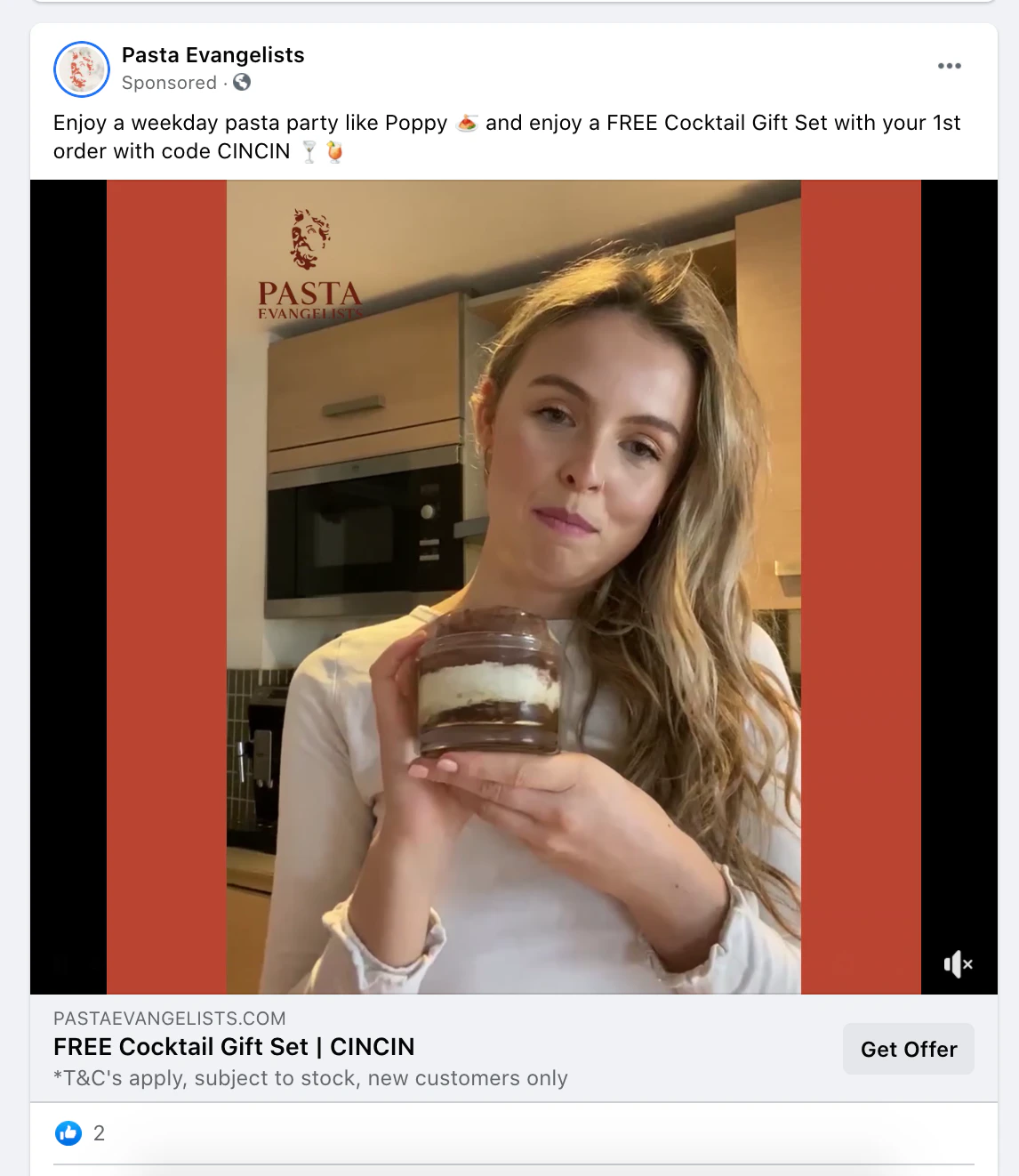
Pasta Evangelists is one of the UK’s fastest-growing food startups and was established in 2017. Because they’re still building brand awareness, they implement paid media tactics, such as sponsored Facebook posts to spread their message.
In this example, they have targeted me with a video containing a promotional code (I fall into their target audience!) and because this is a sponsored post, it is essentially pushed in front of me whilst I browse through my newsfeed, with the aim for me to click on the ‘get offer’ button and convert to a sale.
The pull part
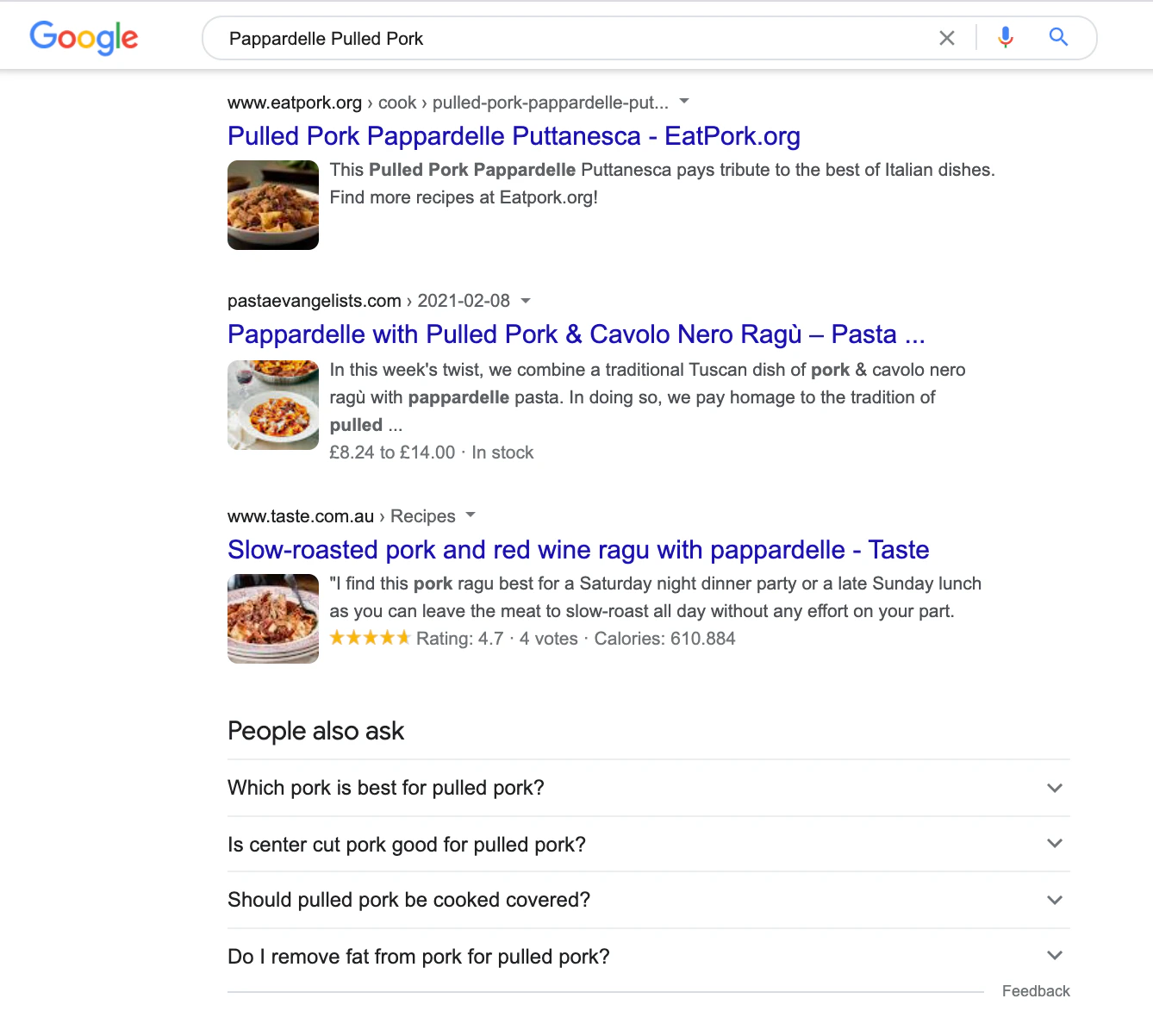
Meanwhile, the Pasta Evangelists team are also working on their pull tactics in order to build brand loyalty and draw customers in. When searching for a recipe for ‘pappardelle pulled pork’ the search results returned a link to a recipe from the Pasta Evangelists website.
As is highlighted in my search query, I was already looking for pappardelle pulled pork, and was therefore further down the AIDA funnel, in the ‘desire’ stage. Whereas before I saw the targeted ads on Facebook, I wasn’t even in the ‘awareness’ stage.
Because I can remember seeing a sponsored post from the brand and the product imagery looks the most enticing out of the results, I am drawn in to click on the Pasta Evangelists website and potentially become a paying customer.
Pull, again
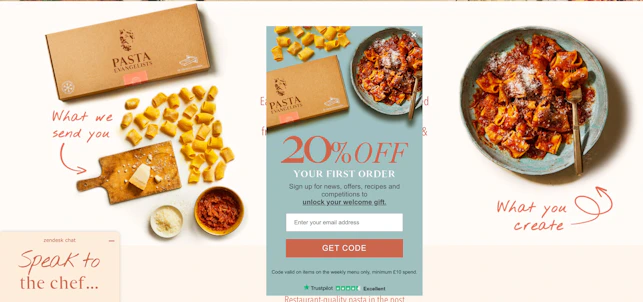
Pasta Evangelists have gone one step further in ensuring visitors to their website are more likely to purchase their products, both immediately and in the future. By inputting an email address, the user can receive 20% off their first order, on the premise that they sign up for marketing emails.
This means that the brand can continue to market to the people who sign up for this offer in the future and also pull in any customers that have either bought their products in the past or may have abandoned their cart during the conversion process.
Push and Pull Marketing FAQs
1. Can a business survive using only one of these strategies?
Yes but it is difficult to scale effectively. A pull-only business relies entirely on customers already knowing what they need. If no one is searching for that specific product or solution, you won’t grow. Meanwhile, a push-only business often faces high costs because they have to pay for every interaction.
2. Which strategy is more expensive?
Push usually has a higher immediate cost because you are paying for visibility (ad spend, sponsored posts, or billboards). Pull is often seen as ‘free’ but it mostly requires an investment of time, creativity and expertise to create the content that earns results.
3. How has the ‘Messy Middle’ changed these strategies?
The messy middle is the loop where customers research and evaluate before buying. This has made the two strategies inseparable. You might use push to get a customer’s attention, but if you don’t have a pull strategy (like reviews or helpful articles) ready for when they go to research you, they are likely to end up buying from a competitor who does.
4. How do I know which one to start with?
If you are a brand-new business, start with push. You need to generate immediate awareness and get your first few sales to build momentum. As you grow, you should shift more energy into pull tactics to build long-term authority and reduce your reliance on paid ads.
5. How do I measure the success of each?
- Push: Focus on immediate impact. Track metrics like reach (how many people saw you), click-through rates and direct conversion rates from your paid campaigns. You are looking for a clear return on ad spend.
- Pull: Focus on authority and growth. Track organic search rankings, the volume of people searching specifically for your brand name, and engagement metrics like ‘time on page’—which proves that the content you’re providing is actually solving the user’s problem.
6. Is Social Media considered Push or Pull?
It is actually both. When you pay for a sponsored post to appear in the feed of someone who doesn’t follow you, that is push. When you post helpful, entertaining content as part of your paid social strategy (that your followers choose to engage with and share) – that is pull.
7. Does AI make Pull marketing harder?
It makes it more competitive. Since AI can now summarise information for users, your pull content needs to be highly original, deeply expert, or based on unique data to ensure you remain a primary source that people want to visit directly. Find out more about how to succeed in AI generative search.
Conclusion
Ultimately, the most effective digital marketing doesn’t force a choice between push and pull – it integrates them into a unified ecosystem. While push marketing is the engine for demand generation – proactively reaching audiences who may not yet realise they have a need – pull marketing is the key to capturing and validating that demand during the research phase.
AI has blurred these lines even further. Success now requires using predictive precision to push the right solutions to users before they search, while maintaining human-led authority to ensure your brand is the ‘pull’ answer prioritised by AI assistants.
Key Strategic Pillars
- Use push tactics like paid social to spark latent demand and pull tactics like SEO to be present when customers actively seek solutions.
- As products become more complex or expensive, your strategy should shift toward pull-heavy tactics to educate and build trust.
- Use push to get attention, but rely on pull content (reviews, guides, expert articles) to prevent customers from drifting to competitors during their evaluation.
- Lean on push for quick cash flow and brand launches and invest in pull for long-term loyalty and reduced reliance on ad spend.
Start mastering your push/pull marketing strategy today by getting in touch today.