This month, we bring you some exciting developments and updates from the world of search, with a clear focus on tailoring AI search results in Google and an upgrade to WordPress e-commerce websites.
The start of a large shift, and a slightly controversial one, is happening in e-commerce: Google has started initial tests for AI-generated shopping ad descriptions, creating new product descriptions for paid advertisements, allowing for easier and quicker product uploading. However, controversy over the use and effectiveness of AI descriptions, especially when businesses have paid for the space, may potentially halt these efforts. Watch this space. Google have made further controversial changes, with initial tests to move away from CAPTCHAs, instead forcing users to own a Google account to prove they aren’t a bot. Whilst this may not be a problem for many, some users have found the more restrictive model needless and more invasive than what they’re used to.
On the technical front, there has been some volatility in July despite the lack of a Google update, leading to many wondering what is causing the fluctuations. WordPress Engine has also partnered with BigCommerce in an attempt to scale WordPress stores and improve the e-commerce experience.
We’ll explore these updates and more in detail in the article below.
Allow our traffic light system to guide you to the articles that need your attention, so watch out for red-light updates, as they’re significant changes that will require you to take action. In contrast, amber updates may make you think and are worth knowing, but aren’t urgent. And finally, green light updates, which are great for your SEO and site knowledge, but are less significant than others.
Keen to know more about any of these changes and what they mean for your SEO? Get in touch or visit our SEO agency page to find out how we can help.

Google Tests & Updates

Google has released their new Gemini variation: Gemini 3.5 Flash Lite. This new variation is designed to handle low-latency, high-throughput tasks and targets agentic search workflows and document processing to provide instant assistance for detailed informational queries.
As a result of its speed and detail, it has been utilised for search engine queries, with many informational queries now being automatically routed to this model for in-depth AIOs. This also supports Google’s new informational agent, the LLM they are using to provide paying members with around-the-clock updates and research on certain topics.
Initial reviews of this feature have been positive, with many users saying the model is more detailed in its responses than previous models and that the conversation flows more seamlessly, making for easier reading and an enhanced “conversation”.

Google has begun initial testing on AI-generated descriptions for paid shopping advertisements in an attempt to provide users with concise, comparable reviews of each product for easier buyer analysis. The aim is to allow users to make more informed decisions with an objective analysis of each product rather than relying on persuasive marketing language from the company itself.
This choice, however, is frowned upon by the companies paying for their advertisements that want their chosen product description to be shown. Sellers are worried that their brand messaging and tone of voice will be lost due to these AI descriptions and are cautious that their Click-Through Rate may decline as a result.
Whilst this was a small initial test, we could see these AI descriptions become more mainstream in the future. Watch this space.
Google seems to be moving away from the traditional CAPTCHAs we are all used to, as they are testing asking searchers to sign in to their Google accounts to prove they aren’t a bot. According to users, Google will stop showing you search results until you sign in to verify you’re human; however, the test was so limited that users are unsure of whether this is a deliberate feature Google is implementing or merely a glitch.
Nevertheless, it has sparked some controversy among users who feel the cancellation of CAPTCHAs for sign-ins is unnecessarily restrictive, with some questioning whether it is really the best way to verify if you’re human or merely there in order to collect more data from their users.
Google Algorithm Updates
Google showed some volatility throughout the month of July, starting on the 18th and 19th and lasting throughout the week despite the last spam update being in June.
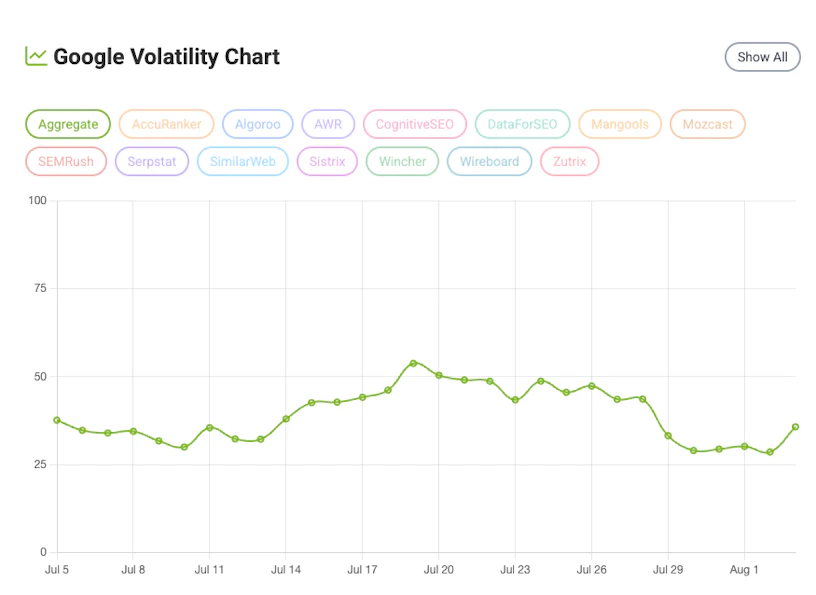
Google have not claimed an update has happened in this time, leading many users to speculate on the cause of the volatility, with many fingers pointing towards recent releases of new AI search engines and LLMs taking away traffic from organic SEO.
WordPress Partnership
WP Engine has partnered with BigCommerce in order to scale WordPress stores and create greater continuity between site building and e-commerce elements. They have stressed they are not replacing platforms, but instead trying to expand upon existing ones and grow in size whilst retaining optimal performance.
WP Engine is prioritising migration of e-commerce sites without downtime or a decline in SEO, and so they have preserved all of the WordPress SEO, design, and user experience elements. They plan to grow into the “next step” for businesses outgrowing e-commerce platforms like WooCommerce, providing a bigger scale of e-commerce website with ties into SEO and personalisation. This expansion will hopefully create a more seamless platform that can appeal to LLMs and Agentic search better than before.
Keep an eye on our blog for the latest Google Algorithm updates, or get in touch if you want to discuss your digital solutions, such as SEO, for 2026 and beyond.