This month, we bring you exciting developments and updates from the world of search, with a clear focus on changing AI search results in Google and the first move in AI advertising.
A major shift is happening in AI, with LLMs like ChatGPT and potentially Gemini moving towards paid advertisements appearing in their responses. ChatGPT is already utilising ‘sponsored agents’, individual AIs each tailored to a specific brand’s identity and expertise, designed to answer questions about products cited in the main response in further detail to encourage purchases.
Google has also started paying businesses a small sum of money based on how often their sources are cited in return for their expertise and information, building their AIO database to be more knowledgeable. Google has also started applying AIOs to large brand names rather than purely informational queries, and has released ‘business profiles’ in which their AI will summarise a business for users to understand what they stand for in an easy format.
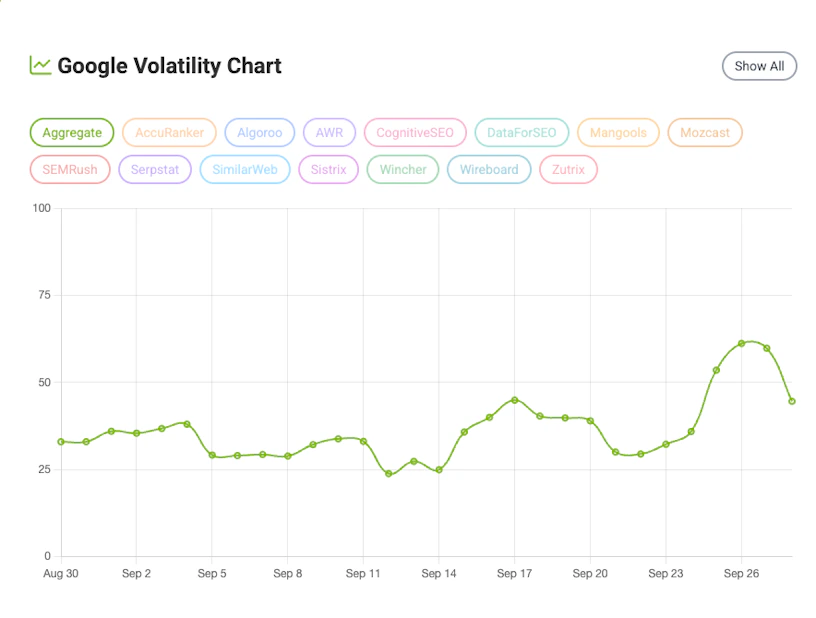
On a technical front, there has been some volatility at the end of September following a spam update, presumably designed to fine-tune the recent rise in AI search.
We’ll explore these updates and more in detail in the article below.
Allow our traffic light system to guide you to the articles that need your attention, so watch out for red-light updates, as they’re significant changes that will require you to take action. In contrast, amber updates may make you think and are worth knowing, but aren’t urgent. And finally, green light updates, which are great for your SEO and site knowledge, but are less significant than others.
Keen to know more about any of these changes and what they mean for your SEO? Get in touch or visit our SEO agency page to find out how we can help.
In this post, we’ll explore:

Google has a small pilot called the AI contribution pilot, where they are paying some publishers in return for using their content in AI Overviews and Gemini. It has now been revealed that this pilot consists of around 100 publishers who are getting around less than 0.1% of their advertising revenue.
Supposedly, payments depend on how often Google uses their content in the AI answers, and so there are varying payments being dealt between the 100 businesses, yet the individual payments apparently change month to month without a reason. Whilst any money is good for a business, the lack of transparency with the payments has got some businesses confused and mildly annoyed at the inconsistency of the payout.

Google has previously, with the rise of their AIOs, created automated ‘business profiles’ for any large business with the help of AI. The issue many had was that the AI included false statements, statements that did not align with their brand identity, or excluded important elements of their business that they would want shared.
They have now created a way to edit and revert these business profiles through a ‘collected info’ tab in the ‘business information’ settings. This has eased a lot of tensions, allowing brands to have control over their own profile. If you have a business profile, it is recommended that you check it and make sure it is accurate.

Google’s AI Overviews have historically only returned results for informational queries and long-tail questions, providing in-depth context for the reader. Recently, however, Google AIOs have started providing contextual information for large brands such as Amazon, Wikipedia, Reddit, etc.
The overviews mainly provide the reader with context on the company, such as when it was created, its owners, what it may sell, its services, and more. With links in the AIO itself, these snippets are pushing the real brand’s links further down the SERP. Whilst this is still beneficial for the brand in question, it makes it harder to track clicks towards your own brand.

Google has released a spam update at the end of September, with September 25th causing a lot of volatility for businesses. The volatility ended on September 27th, but shifting rankings remained for the two-week rollout. Many have claimed that the new spam updates are having more of an impact on rankings than in previous years, likely due to the new spam available with AI tools.
It is suspected that a few different spam tactics, such as fake profiles, will be targeted by this update.
Source: seoroundtable.com
SEO, Lily Ray, put forward an interesting prediction for the next massive Google update. In light of the recent and frequent spam updates, she predicts a massive Google algorithm update targeting scaled AI content, fake authorship, and manipulative GEO tactics.
Since Google updated its algorithm documentation in October to specify restrictions on fake authors and present more guidelines for using AI content, and with the shrinking gap between spam updates, it is a fair prediction that Google is gearing up for a large algorithmic change regarding GEO exploitation.
ChatGPT have taken the first step in including advertisements as part of its LLM, and in September they have enhanced this feature. They have introduced ‘sponsored agents’, individual AIs each tailored to a specific brand’s identity and expertise, designed to answer questions about products cited in the main response in further detail to encourage purchases.
Brands that purchase ad space can also sponsor an event, tailoring it to the brand and filling it with their product knowledge to make it so users can simply click on a product suggested by ChatGPT and ‘speak to the brand’ directly.
Keep an eye on our blog for the latest Google Algorithm updates, or get in touch if you want to discuss your digital solutions, such as SEO, for 2026 and beyond.