Why is it that every year, a small group of brands keep growing through paid media advertising, while the majority hit a plateau?
We’ve helped hundreds of brands to outperform in their market, and there is a repeatable behaviour behind the brands that succeed.
And it runs counter to the advice we’ve all grown used to hearing.
The trap of best practice
When I say “best practice”, I’m talking about the playbooks gifted to us from years of iteration. First from Meta and Google, reinforced by respected voices in the industry, and often baked into our own processes over time.
It’s not bad advice. For many brands, ensuring best practice is in place really does deliver a short-term lift. From experience, I’d estimate that four in five advertisers will see some level of performance gain by implementing the “gold standard” recommended by Meta or Google.
But with AI and automation accelerating, with products like Advantage+ and Performance Max doing more of the heavy lifting, it’s easier than ever to tick the best-practice boxes. This means it’s harder than ever to achieve a real competitive advantage by doing just that.
So following the playbook doesn’t put you ahead; it just moves you into the middle of the pack. To outperform the market, you have to compete differently.
Who benefits from best practice?
While best practice can be your enemy, it is almost certainly the ad giants’ friend.
Why? Because advertisers mimicking the same strategy is good for the platforms’ aims. The more advertisers use the same techniques, the more competitive those approaches become. In turn, this drives up CPMs, CPCs, and ultimately your cost of sale.
If every advertiser in your category is feeding the machine the same kind of data, running the same strategy, with the same campaign structures, and chasing the same audience signals… the auction becomes crowded. You’re paying more for the premium of targeting the same users.
That’s the hidden cost of best practice. It delivers reliable results, but ultimately leads to diminishing returns.
Don’t get me wrong, I understand why CMOs lean on best practices. It reassures boards, ticks governance boxes, and keeps things defensible.
But safe and same have become too closely linked, and for a performance marketing team, sameness is the riskiest place to be.
The Edge Gap explained
This is what I call the Edge Gap.
On one side, there are brands stuck in iteration mode. Tweaking, optimising, doing just enough to show efficiency gains. They take on the latest platform updates and follow the rulebook to the letter. But now, they have to work harder and harder to maintain performance.
On the other side, there are brands in exploration mode. Producing ideas that break with the playbook, testing ways of working that feel unfamiliar, and pushing platforms in directions they weren’t really designed for.
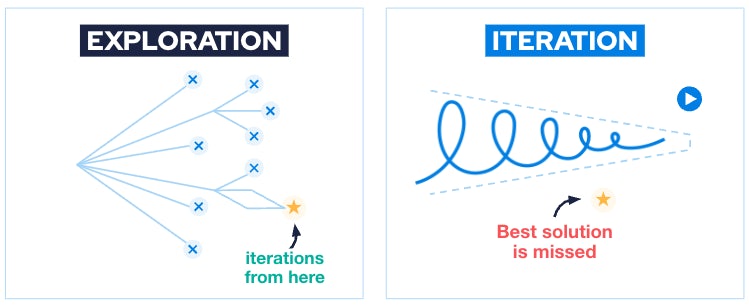
The Edge Gap is the widening space between the two. And the only way to close it is experimentation.
Where to run your boldest experiments
If experimentation is how you close the Edge Gap, there are three primary areas to focus your testing:

Creative → Forget perfection. Focus on velocity and diversity. The biggest winners don’t polish a single “hero” ad; they test wildly different concepts until something cuts through. You may believe you’re testing your creative, but unless you have multiple, very different concepts in play, you’re being too safe.
Signal → Stop explicitly trusting attribution. It only shows correlation, not causation. Instead, develop your own understanding of performance by consistently running incrementality tests, not just switching things on and off at a channel level, but isolating the true, incremental revenue impact of each campaign. Experimentation is the only way to determine cause.
Activation → Don’t just plug and play. Yes, broad automation works, but it’s not the whole story. Look for first-mover windows, dig under the hood with things like conversion APIs, and don’t be afraid to use parameters in unconventional ways. Many market-leading brands are now experimenting with synthetic data to optimise bidding, removing outliers to rein in bid aggression.
This is where real edge comes from. Not reckless bets, but deliberate exploration layered on top of a solid base of best practice.
Five ways to compete differently
So how do you put this into practice without losing control? A few shifts to start with:
- Split your budget. Ring-fence 5–10% of spend for exploration. That might mean new channels, new campaign types, new formats, new concepts or new targeting. The point is: Make experimentation a habit, not a gamble.
- Set creative velocity targets. Don’t wait for one perfect ad. Ship new assets regularly, across at least three distinct ideas, not just colour or CTA swaps of the same ad. Treat creative like a portfolio of bets.
- Discover true causality. Commit to one meaningful incrementality test per quarter. Pre-register your hypothesis and hold the line until results are significant. No more “switch it off and see what happens” shortcuts, design experiments that tell you what really drives revenue.
- Interrogate your signals. Don’t just feed the platforms the data they ask for. Understand how the data is used, and where you might bend it. That might mean cleaning or enriching audience data, using synthetic events to steer bidding behaviour, or enhancing product data in ways your competitors haven’t thought of.
- Exploit the grey. For every platform, identify at least two underused parameters or features and test them. Go beyond the help docs. Break things. Use the tools in ways they weren’t designed to be used. That’s often where the biggest edge is hiding.
None of this means abandoning best practice. It means building on it with purpose, and proving the value of exploration through structured learning.
Breaking away from the pack
If your marketing playbook looks identical to your competitors’, don’t be surprised when your results do too.
Best practice makes you average by design.
Four out of five advertisers will see a lift from following the gold standard. But only one in five will break through because they’re willing to explore where others stop.
Exploration is the only path left to differentiation. The brands bold enough to experiment today will set the benchmarks everyone else tries to follow tomorrow.
The question is: Are you brave enough to be the one in five?