AI search metrics are the latest hot topic for discussion in SEO and digital marketing. It all started with SERP features that we thought were pretty nifty. Featured snippets, People Also Asked (PAA), passage ranking and more. We benefited from it for years, with lots of flashy features to report on that supported brand visibility. Now we’re back at the start and having to figure out how to report on AI brand search visibility.
People used to ask Google. They still do, but a huge part of the user journey has suddenly gone dark because SEO tools are playing catch-up with the likes of ChatGPT, Claude and Gemini.
This isn’t exactly a surprise; we’ve been heading this way for years. Now that AI Overviews and chatbots rule the roost in the research phase of the customer buying journey, enterprise traffic is taking the hit, according to a study by Conductor. Their study revealed that 71% of large-scale websites have seen a traffic drop of 10% or more since the rollout of AI Overviews.
Companies that have long and complicated sales funnels may have invested in supporting their customers (potential and acquired) through this process, meaning that they may be seeing even larger year-on-year session declines.
We have been relying on these sessions and click metrics for years, but we adapted when GA4 adapted to engagement metrics, and we’ll adapt once more.
It’s easy to be spooked by a red number in a report, but in this blog, we’re going to shift the conversation from “How much traffic did we get?” to “How often is the AI recommending us as the solution when we are seeing less traffic?”
If you’re looking to discover how to show up in AI, my colleague, Rhianne Moriarty, wrote a comprehensive piece about how to optimise for generative AI search. You should definitely check that out too.
Click the links below to read more:
- What are the questions about AI search metrics that every CMO should be asking?
- How to report on brand visibility in AI search
- Citations and mentions are essential AI search metrics
- Sentiment: What is the AI’s "Opinion" of You?
- How to report on the AI vibe-check?
- What metrics should AI search reporting include?
- How can Impression help me with AI search?

What are the questions about AI search metrics that every CMO should be asking?
There is an influx of AI tracking tools hitting the market and an incredible amount of chatter on LinkedIn with opinions ranging from old man shakes fist at cloud to some really spicy takes.
It is incredibly easy to complicate this, and it’s in a lot of people’s interest to do so. As a high-level marketing leader, five key questions need to be answered:
- Are we visible in AI?
- How do we appear in AI search?
- How do we report on AI visibility?
- How do we connect AI search activity with revenue?
- What do we own that AI cannot replicate?
These aren’t just technical queries for the SEO team to handle in a vacuum. AI poses risks to marketing budgets because it is getting harder to have full sight of the sales process, attribute key decision milestones to a specific activity, and tracking will likely involve unquantifiable investment upfront.
If you can’t answer these questions today, your competitors might, which gives them an incredible head start in a market that is moving faster than any algorithm update we’ve seen in the last decade. But once you start asking these questions, you quickly realise how much the game of measuring success in organic search has changed.
To win in this environment, we have to do this:
- Zoom In: Sentiment and Narrative Positioning – We need to understand the “opinion” AI has of our brand. It’s not enough to be mentioned; we need to know if we are being characterised as a “premium enterprise solution” or a “budget-friendly alternative”. By analysing the sentiment of specific prompts, we can identify “perception gaps” where the AI’s synthesised answer drifts from our actual brand mission.
- Zoom Out: The Citation Ecosystem – On a macro level, we must track our Citation Share—the absolute number of times AI engines (like ChatGPT, Perplexity, and Gemini) choose us as a source compared to our competitors. We then layer this against traditional organic session data to identify where “Zero-Click” AI answers are cannibalising our traffic versus where they are acting as a high-conversion referral engine.
- Contextualising Data for your Strategy – We are bridging the gap between technical visibility and your core business outcomes. We recognise that a 10% shift in organic traffic is a secondary concern when it is outweighed by gains in conversion rate or average order value (AOV).
- Take Decisive Steps – Measurement is useless without a pivot. If the “zoom out” shows a gap in citations, the move is to strengthen your brand as an entity, meaning getting cited by authoritative sources is no longer a ‘nice to have’.
There isn’t time to lose. In the past, we have faced cross-device attribution challenges, privacy restrictions, and found our way through dark social. These past challenges were blueprints for the agility we now need, as AI-driven platforms rewrite the rules of the customer journey.
When the funnel has gone dark, and we don’t know what our customers are seeing, we have to pivot our search strategies so that we are chasing revenue, not ghosts.
With this in mind, what AI search metrics really matter when it comes to your reporting?
How to report on brand visibility in AI search
People love to say “SEO is dead.” This is dead, that’s dead. Yawn. It’s not true. It’s ragebait.
In traditional search, we can report on Share of Voice, but how does this translate with the AI shift?
Share of Voice (SoV) isn’t going anywhere, but be prepared to see changes in SoV metrics. SoV measures a brand’s visibility in organic search results compared to competitors. It factors in search volume and ranking. The metric gives a tidy number to represent the digital marketing share. Just remember, it calculates this based on a brand’s estimated traffic.
We adapt by bringing in a Share of Model (SoM) metric. This is called AI Search of Voice if you’re using Ahrefs. You might see it called ‘Brand Citations’, ‘Engine Dominance’ or something completely different. It is not an industry-standard metric.
This metric works in a similar way to SoV; it is the percentage of AI-generated responses that include your brand vs your specified or tool-selected competitors for high-intent topics.
By understanding how you measure up on a macro-level, you aren’t guessing. You know how your brand’s visibility in AI search measures up to competitors.
The CMO Takeaway
Clicks and sessions are now only part of the story. Measure your brand’s visibility against competitors and invest in the authority required to get there.
Find out how with generative engine optimisation.
Citations and mentions are essential AI search metrics
It’s really easy to get citations and mentions mixed up, so for clarity:
- Citations – when an LLM cites your content by linking to it.
- Mentions – an AI model mentions your brand in a response.
I have shown this in a screenshot below using Ahrefs.
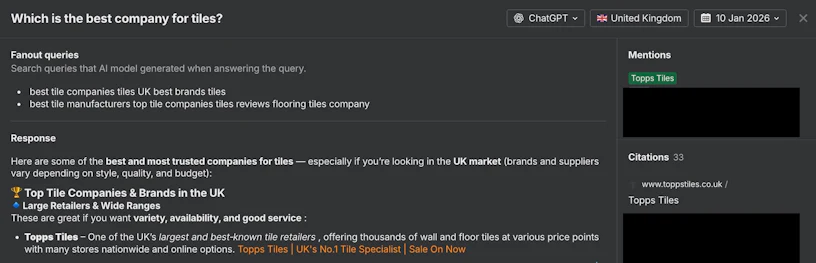
This screenshot shows that if you are only appearing in the citations, the harsh interpretation is that you’re only helping the LLM sell your competitors. In reality, we don’t yet have the behavioural data to know if users are paying attention to citations. What we know for sure is that they don’t get clicked anywhere near as much as blue links in traditional organic search.
This is even considering studies have shown that organic CTR for AI Overview queries have dropped 61% to 0.61%. This is a figure that we can corroborate across a range of verticals.
That’s not the end of the story, hope is not lost! Citations are the lead in to getting these mentions. They are a leading metric that suggests that the AI is aware of you, it’s just not ready to stake its reputation on you yet.
The CMO Takeaway
- The number of citations is the AI search metric that answers the question, “Does the AI know we exist?”
- The number of mentions is the AI search metric that answers the question, “Does the AI like us?”
Both metrics get you closer to constructing the narrative you need to put forward to your board.
Sentiment: What is the AI’s “Opinion” of You?
Over the last 20+ years, we have been so used to Google “democratically” serving us a list of links to a search query that may or may not take into consideration sentiment. That was until AI Overviews started providing summaries.
AI doesn’t just show your website with the framing that you specify; it collates and repackages everything it knows about you. Good, bad and even ugly.
Users know that AI-generated summaries are based on far more context and information than they can realistically consume, and so if AI says your product is “reliable but expensive”, your price-conscious customer has already disregarded you, even if they don’t know how much your product or service costs yet!
This is compounded by AI opinions hanging around until the model is retrained on new data, which makes inaccurate or negative sentiments problematic in the long run. It is worth noting that some models update in near-real time. However, less optimal information pales in significance; it’s not scrubbed from existence.
How to report on the AI vibe-check?
This isn’t fluffy stuff. If you aren’t measuring the “vibe”, then you’re missing out and in danger of falling victim to the AI shift rather than owning it.
We use focus groups, net promoter scores and all manner of qualitative research to hear the voice of the customer.
It’s important to understand how sentiment is balanced between positive and negative, but the tools on the market will help us go even further.
At Impression, we have proprietary AI tools that help us process large quantities of data faster and in an innovative way that protects our clients’ data.
The CMO Takeaway
Sentiment analysis is no longer just for social media monitoring. It must be audited and included as part of your integrated SEO and Digital PR strategy. You aren’t just optimising for keywords anymore; you are optimising for a compelling narrative that captures hearts, minds and imaginations.
What metrics should AI search reporting include?
Numbers on a scorecard mean nothing without analysis and context. People who used to use your website to research their purchase decision lost to the chatbots, which means that we have lost visibility into research behaviour that happens inside AI tools.
AI reporting tools are flooding the market, and the amount of data at our fingertips is, in many situations, mushrooming into something the human brain cannot process.
This is where the CMO steps in: with the calm narrative that doesn’t just reassure your board you know what you are doing, but backs up and speeds things up when you make your case for more or diverted investment.
Here are some example situations and narratives you might be facing.
| What has happened? | What this looks like | So what? | Create a narrative |
|---|---|---|---|
| Visibility loss in informational queries | Clicks for “how,” “what,” and “why” keywords have tanked. | AI Overviews are providing “Zero-Click” answers. We are still the source, but the traffic stays on the SERP or chatbot. | “While top-of-funnel traffic is shifting to AI-hosted answers, our brand is serving as the primary ‘knowledge source,’ building authority before the user even clicks.” |
| Total organic sessions are down 15% | Blog and informational content traffic is 40% lower. | Traditional traffic metrics are now “ghosts”. We need to pivot to include Share of Model (SoM) in addition to Share of Voice. | “We are losing low-intent research traffic to AI, but our high-intent brand citations are increasing, protecting our bottom-line revenue in AI search.” |
| YoY search volume is down 10% | Clicks to specific product/service pages are down 20%. | Users are making decisions inside the LLM chat. If the AI doesn’t mention us as a top choice, we lose the lead. | “Our organic traffic is leaner but more qualified. By dominating AI Mentions, we are capturing users at the exact moment of decision-making.” |
| We don’t agree with AI sentiment of our brand | AI incorrectly summarises your brand as “budget” or “expensive”. | The AI is repackaging your brand narrative. Negative sentiment here is “sticky” until the model re-trains. | “We are adapting our strategy to ensure our digital PR and content align with our premium positioning, preventing the AI from mischaracterising our brand mission.” |
| Our traffic is lower, but we’re seeing higher revenue | Conversion rate shifted so quickly, we thought it was a tracking issue! | Users are preferring AI chatbots who are filtering out casual browsers. | “AI is pre-qualifying website visitors. We need to ensure that we focus our search strategy on being present and closing the sale.” |
| Our smaller competitors are being mentioned above us, even though we rank higher | ‘AI mentions’ metrics for small competitors are higher | We have a “Third-Party Validation” gap. Potential customers will think our competitors are better | “AI models prefer third-party verification.* We need to prioritise third-party validation through marketing and incentivising customers through satisfaction and reviews” |
* This is inferred based on observational data, but not confirmed through formal documentation.
The CMO Takeaway
Your role is to shift the board’s focus from what is missing to a calm narrative that connects new AI reporting metrics to revenue and brand authority. This newly available data clearly shows which areas might have previously experienced underinvestment in your organisation, e.g. incentivising brand advocacy or third-party verification through digital PR activations.
How can Impression help me with AI search?
In this blog, we have explored just a fraction of the changes we have seen in the search landscape. Working with Impression, we support all of our clients, whether enterprise ecommerce, SaaS service or charity/not-for-profit organisations, navigate an ever-changing landscape.
With us, you move past defending surface traffic losses, but identifying high-value opportunities that move away from vanity metrics. We turn that into something real.
Contact us today to build a search strategy that drives your brand in the AI search space.