When presenting results of a Marketing Mix Model (MMM), the go-to graph to display is a waterfall chart, representing the contributions from all media channels. However, there is always the question. What is the baseline?
Firstly, a quick recap on MMM. Marketing Mix Modelling is a statistical technique that measures the impact of marketing activities. Simply put, the equation looks like this:

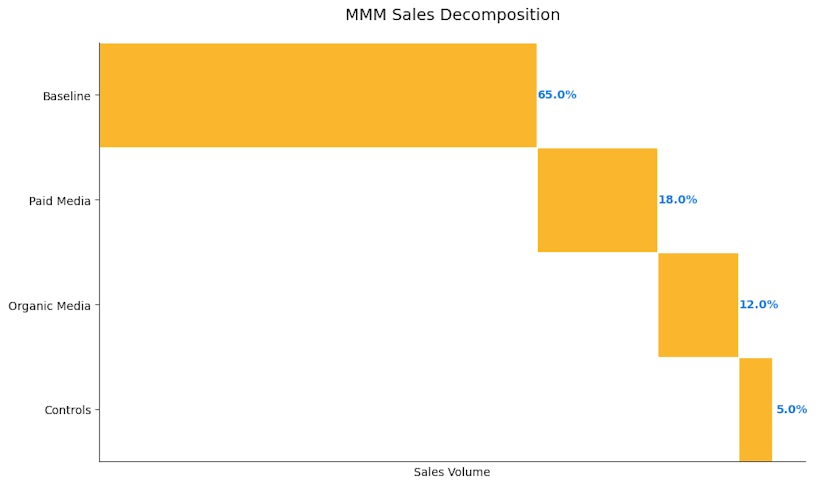
Paid Media (i.e. Google Ads, Display & Video, Paid Social), Organic Media (i.e. SEO, Digital PR, Organic Social) and Controls (i.e. potential non-marketing factors, such as seasonality, and macroeconomic factors) all make sense to stakeholders as an input into MMM. However, the Baseline is the input that often needs an explanation.
What does a baseline in an MMM represent?
The Baseline in MMM represents the sales for the business that would happen if all marketing efforts stopped and all organic activity ceased. If this happened, we would still expect sales for the business. This is due to:
Brand loyalty & reputation: The cumulative effect of brand building over previous years.
Customer retention: Repeat purchases from your existing customer base that happen without a marketing nudge.
Word of mouth: Organic recommendations that aren’t tied to a specific recent campaign.
Put simply, it is the revenue the business captures solely through its presence in the market, rather than its recent marketing activity.
What level of baseline is normal?
This is a common question from stakeholders. There is no specific answer to this, but based on the type of business and its market share, we can give a rough guide.
High baseline
- Established household goods, utilities, and mature subscription services where sales are driven mainly by habit, contracts, or being available in every store.
Medium baseline
- Retail stores, car manufacturers, and fast food businesses are examples where people are familiar with the brand, but advertising is needed to prompt a purchase.
Low baseline
- New online-only brands and mobile apps, where few people know the product, so revenue naturally relies almost entirely on paid advertisements to find customers.
Is a high baseline bad?
Again, this question has differing answers depending on the context. Many stakeholders will see a high baseline and think their marketing activity is not performing well, but this isn’t always the case. There can be many reasons for a high baseline.
Low marketing spend
- If marketing spend is already low, we cannot expect paid media to be a large contributor to sales
Low variance in spend
- When a channel has a consistent spend, it’s hard for the model to notice a relationship between it and revenue, and it will therefore under-contribute.
- This leads to the baseline being falsely inflated, explaining the gap that this phenomenon creates.
High Brand Equity
- Most of the sales for the business come because the brand is well established, and all marketing efforts are just to convert those final few who might be on the fence.
The baseline isn’t just a number that fills in the gap; it represents the success of brand building and reputation. Without it, you risk overcrediting your channels using sales that would have happened anyway.