This month, we bring you some exciting developments and updates from the world of search.
Google layered its systems with quieter but meaningful upgrades: Search Console gained future-dated annotations, letting teams map upcoming changes directly onto performance timelines, and a new branded-queries filter to clarify when an audience is searching for you rather than merely near you. Local businesses received more tactical muscle, too, with Google Posts now supporting scheduling and multi-location publishing.
On the broader front, AI kept tugging at the industry’s foundations. Seer Interactive reported that AI Overviews cut organic CTR by 61% and paid CTR by 68% for informational queries. And Google’s agentic tools began booking flights, hotels and dinner, signalling a shift from search-as-navigation to search-as-action.
We’ll explore these updates and more in detail in the article below.
Allow our traffic light system to guide you to the articles that need your attention, so watch out for Red light updates as they’re major changes that will need you to take action, whereas amber updates may make you think and are definitely worth knowing, but aren’t urgent. And finally, green light updates, which are great for your SEO and site knowledge, but are less significant than others
Keen to know more about any of these changes and what they mean for your SEO? Get in touch or visit our SEO agency page to find out how we can help.
In this post, we’ll explore:
- Google Search Console annotations and brand queries updates
- Google Search Console annotations now allow current/future dates
- Google Search Console adds branded queries filter
- Google AI Overviews drive 61% drop in organic CTR, 68% in paid
- Google Business Profiles adds scheduling and multi-location publishing to Google Posts
- Google releases Gemini 3 – it already powers AI Mode
- Google can book your flights, hotels and dinner reservations using AI
Google Search Console annotations and brand queries updates

Google Search Console annotations now allow current/future dates
Google has updated the custom annotations feature in Google Search Console (GSC) to allow users to add notes not only for past dates but also for the current date or future dates. Previously, this wasn’t possible: for example, when a user was trying to annotate the day of a major outage (a Cloudflare issue), Google’s interface rejected the date because it was after the last available data date. On 19 November 2025, that restriction was lifted. Now you can schedule annotations even before any data is displayed.
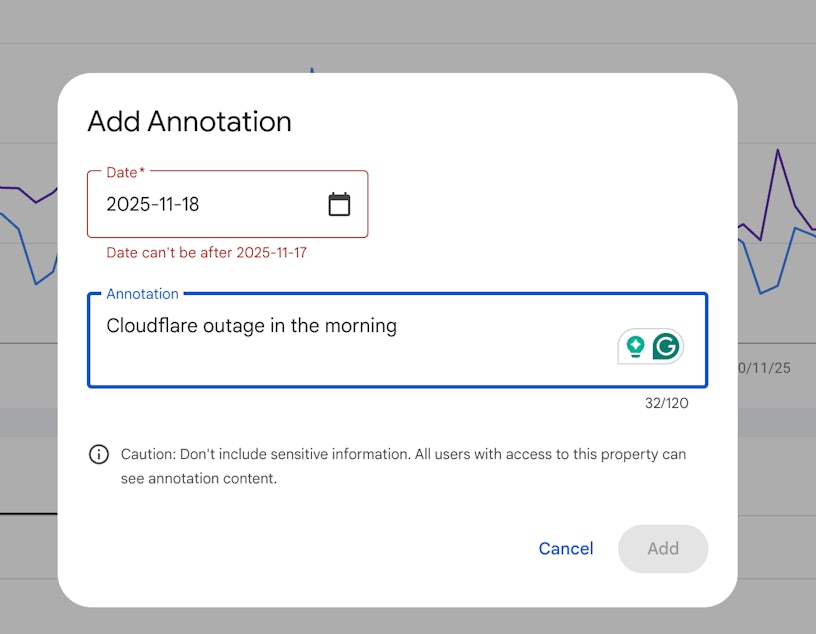
In simple terms, annotations in GSC let you add contextual notes (site changes, migrations, marketing campaigns, outages, etc.) directly on the performance chart. For SEO, this means you can now plan ahead. If you’re launching a site redesign or content overhaul in 2 weeks, you can add an annotation now. Later, when you view performance data, you’ll remember exactly when that change happened, even if nothing was showing at annotation time.
Google Search Console adds branded queries filter
Google announced that new branded query filters are rolling out gradually within Google Search Console reporting.
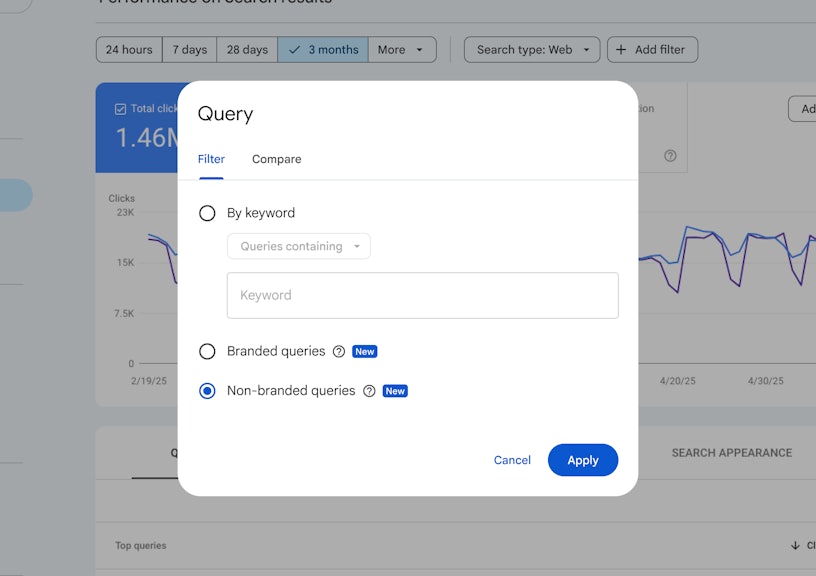
The filter, powered by AI, automatically recognises brand names, variations, product names or misspellings, then shows impressions, clicks, average position and CTR separately for each.
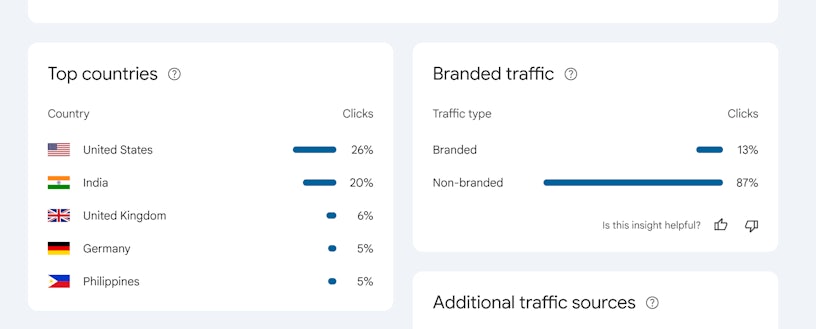
Google has introduced a new feature within the Insights report to help users understand their brand recognition and the effectiveness of their brand presence. This report now clearly separates total clicks into two categories: branded and non-branded queries.
According to Google, this breakdown allows you to “measure brand recognition and compare the volume of traffic from people already familiar with your brand to the volume of traffic from those who didn’t explicitly intend to visit your site.” In essence, it shows the difference in traffic volume between users who were already searching for your brand and those who found you via generic searches.

A new study by Seer Interactive analysed 3,119 informational queries (June 2024 – September 2025) and found that when Google AI Overviews (AIO) appear, organic click-through rates (CTR) plunged roughly 61% (from 1.76% to 0.61%), while paid CTR dropped a larger 68% (from 19.7% down to 6.34%).
Interestingly, even for queries without AIOs, organic CTR fell 41% year-over-year, suggesting a broader shift away from clicks, not just due to AIO presence. However, the study also found that brands cited within AIOs performed better: they received about 35% more organic clicks and 91% more paid clicks than non-cited brands. The pattern holds across a large sample spanning many organisations and millions of impressions, indicating that this is not a seasonal or outlier phenomenon but likely a stable shift.
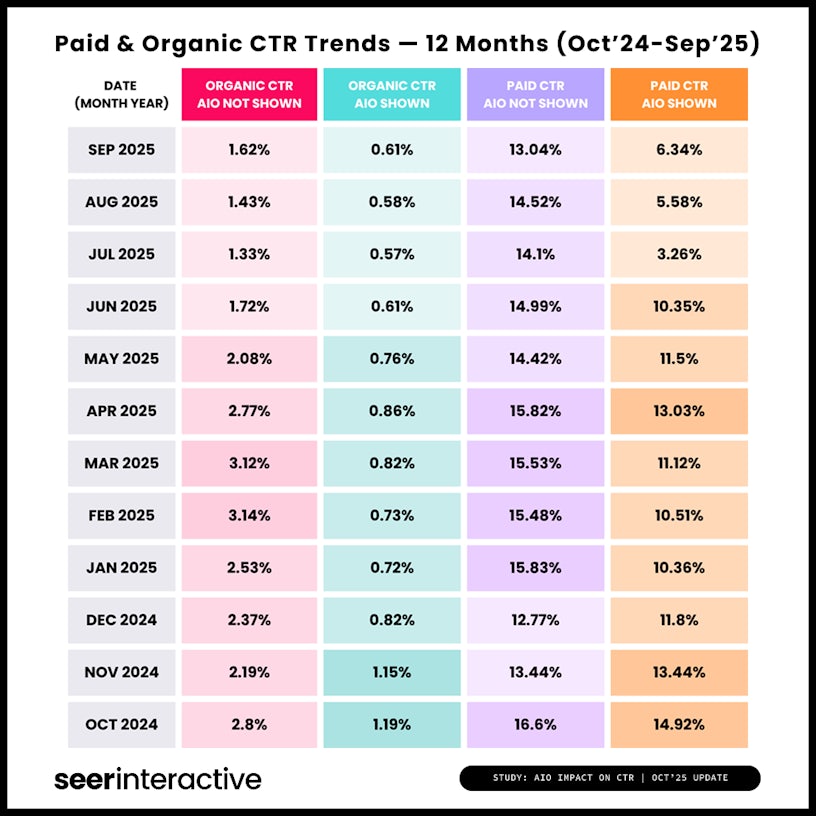
Getting cited by AIOs becomes a new form of visibility. Brands that appear in AIOs see relatively better CTRs than those that don’t. So being findable and quote-worthy becomes more important than ranking or click optimisation.
Rather than focusing solely on clicks and traffic, SEO strategies should shift to measuring visibility, share of voice, brand presence, and conversions. Impressions and AIO inclusion may become more critical KPIs.
It is reported that Google Business Profiles now lets businesses schedule Google Posts to publish at a chosen future date/time, and replicate a single post across multiple locations with one click. This means businesses managing several branches no longer have to manually post separately per location or log in at the exact posting time. As noted by a Google spokesperson, the new scheduling option helps businesses “plan your entire week or month in advance.”
For local businesses and multi-location brands, this adds convenience and consistency. It ensures timely updates, handy around events, promotions, and holiday seasons, and helps maintain an active presence across all locations.
Google has launched Gemini 3, which it touts as its “most intelligent” model, and is now powering AI Mode within Google Search. This new model reportedly features state-of-the-art reasoning, deep multimodal understanding, and “agentic” capabilities. These advancements allow Gemini 3 to deliver dynamic and rich outputs, such as interactive tools, real-time visuals, tables, and simulations, tailored to the user’s specific query.
The introduction of Gemini 3 into AI Mode (currently available to a limited user base, with likely expansion) signals an evolution for Google Search. Search results are becoming richer and more interactive, offering more comprehensive answers, especially for complex, data-driven, or scientific queries. They are expected to rely less on a conventional list of links.
Google AI Mode is introducing “agentic booking” features that let users not only search for but also book flights, hotels, and dinner reservations via natural-language prompts. Initially launching in the U.S. for dinner reservations via partners such as OpenTable and Resy, support for booking hotels and flights will follow later through collaborations with companies like Booking.com, Expedia, and major hotel chains.
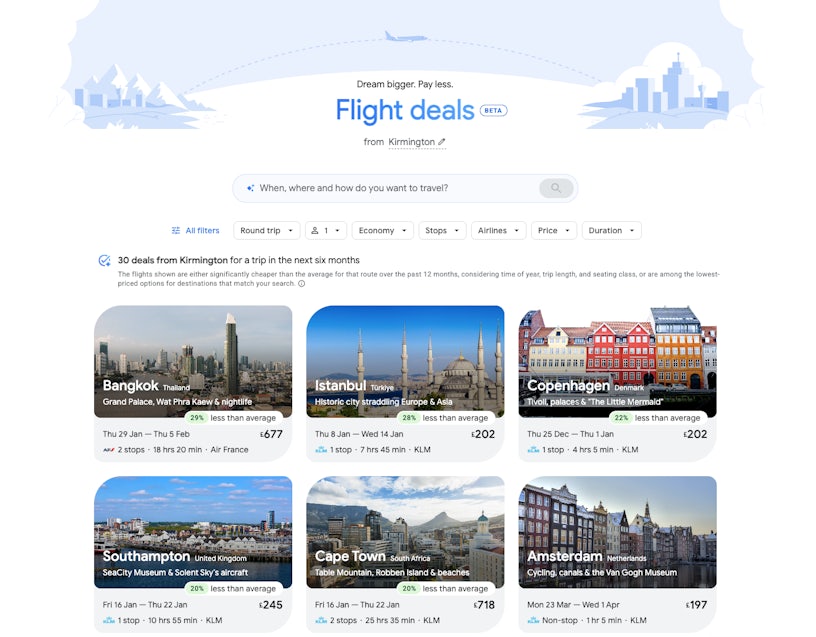
In addition, Google re-launched its “Canvas” planning tool in AI Mode, to help users organise travel plans, from flights, hotels and itineraries to find deals via simple natural-language instructions (“I want a 7-day trip to Morocco under £X”). Flight deals are expanding globally to more than 200 countries, with support for over 60 languages. For travel and hospitality businesses, visibility inside Google’s booking-AI may become as important as or more important than ranking in classic search results.