This month, we bring you some exciting developments and updates from the world of search, with a clear focus on tailoring AI search results for more customisability while allowing for a more convenient e-commerce experience.
A big shift in e-commerce is officially here: Google has launched the Universal Cart, allowing users to buy products from major retailers directly within search results. This intelligent shopping hub means users can add items to a single cart while performing other activities such as Google searches, watching YouTube, chatting in Gemini, or browsing Gmail. It also runs in the background to find deals, monitor price history, and check product compatibility, giving a one-stop shopping experience from research to purchase. Major brands such as Nike, Target, and Walmart have already signed up.
On the technical front, Google has released the data for AI mode usage after one year and revealed that it has reached over 1 billion monthly active users globally. Furthermore, average queries have increased in length by three times. They are also experimenting with ‘preferred’ source labels that will flag specific publications that users prefer and customise their search experience to that, although it is not clear at this point whether or not Google is bringing the source up because it is labelled or merely flagging a labelled source that is already there.
We’ll explore these updates and more in detail in the article below.
Allow our traffic light system to guide you to the articles that need your attention, so watch out for red-light updates, as they’re significant changes that will require you to take action. In contrast, amber updates may make you think and are worth knowing, but aren’t urgent. And finally, green light updates, which are great for your SEO and site knowledge, but are less significant than others.
Keen to know more about any of these changes and what they mean for your SEO? Get in touch or visit our SEO agency page to find out how we can help.
In this post, we’ll explore:

News about AI Mode

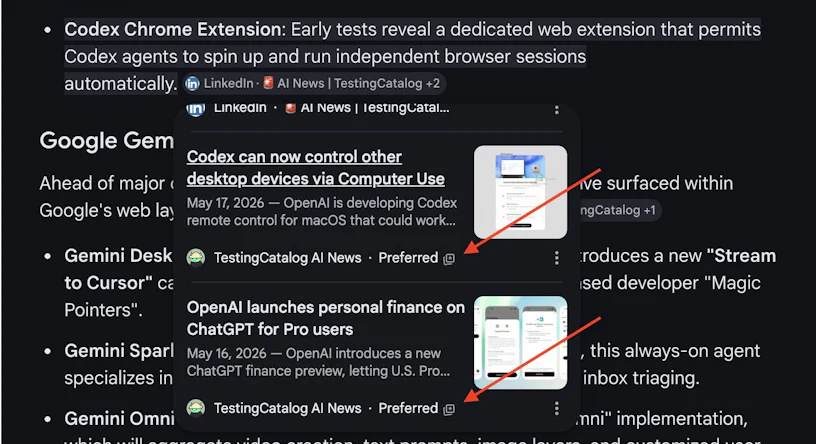
Google is experimenting with deep personalisation in its conversational search by testing a ‘preferred’ source label directly within AI Mode links and citations. This update is tied to a feature where individual searchers can flag specific publications or websites they trust.
While it isn’t fully clear yet whether the AI is pulling the source purely because the user favoured it or if it’s just visually labelling a source that would have appeared anyway, it points to a heavily personalised future for AI Mode. If users can explicitly define their ‘preferred sources,’ brand loyalty and user trust become critical ranking factors for AI visibility.
Here’s a look at the label:
To mark the first anniversary of broad AI Mode availability, Google has released its first comprehensive dataset on how people are actually using it. The headline stat is massive: AI Mode has officially surpassed 1 billion monthly active users globally, with query volume more than doubling every single quarter.
The data shows that the way people search has completely transformed; the average AI Mode query is three times longer than a traditional search, heavily relying on natural, conversational language and terms like ‘explain,’ ‘identify,’ and ‘summarise’. Furthermore, over 15% of all searches are now multimodal (using images, voice, or video), and deep planning queries are exploding at 80% above the baseline.
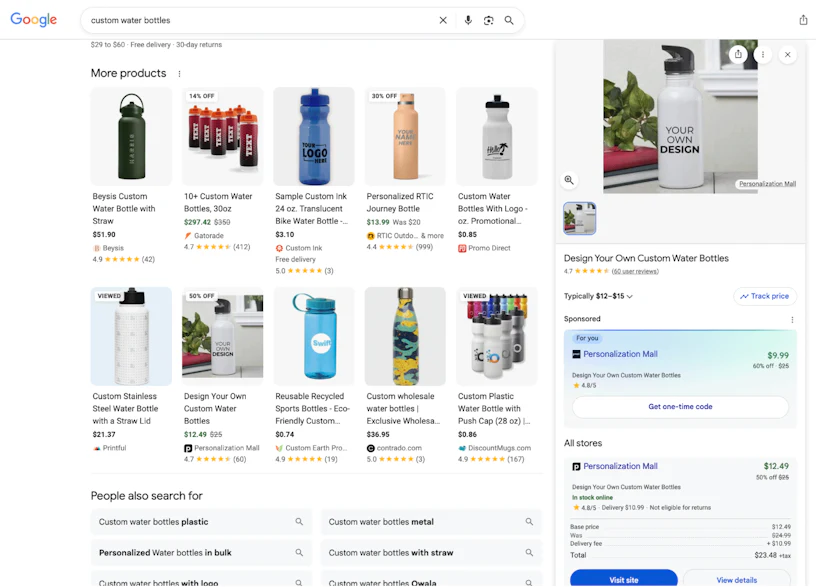
In the e-commerce space, Google is testing a new ‘for you’ label inside search engine product grids and shopping results. This label builds upon existing product tags like ‘best price’ or ‘most popular’ but takes personalisation a step further by offering hyper-targeted perks.
For example, when a user encounters the ‘for you’ label, a prominent, animated ‘get one-time code’ button displays on the result. Clicking it allows the shopper to instantly copy a merchant promotion coupon or jump straight to the landing page. While this ‘for you’ feature has been spotted alongside ‘sponsored’ tags, it reminds us that Google Merchant Centre health and feed management are critical for organic retail success.
Here’s a view of the ‘for you’ label in more detail:

Google has taken a massive step toward fully automated e-commerce by introducing the Universal Cart. Powered by Gemini and the Universal Commerce Protocol (UCP), this is an intelligent, persistent shopping hub that works across multiple retailers simultaneously.
Users can seamlessly add items to this single cart while doing a Google Search, chatting in Gemini, watching YouTube, or browsing Gmail. The cart runs in the background to automatically find deals, monitor price history, check product compatibility (like flagging the wrong replacement part), and calculate loyalty points from Google Wallet. Major brands like Nike, Target, Walmart, and Sephora are already signed up for direct, multi-merchant checkout.
In the face of rising AI use, many people are wondering whether AI automation is coming to replace SEO jobs. But don’t worry. The research shows that, although AI may displace about 9 million jobs by 2030, it will also create 11 million new jobs, creating a net gain.
Whilst marketing roles are an exposed role for AI replacement, this study has found that mundane tasks will likely be replaced with automation, but complex and creative tasks will always require human intervention.
In fact, regarding technical specialists, the study found that when writing code, AI makes 1.7 times more mistakes than humans, showing that the management and review of AI is vital for a productive workflow. It emphasises the need for humans and AI to work together, not for one to replace the other.
Keep an eye on our blog for the latest Google Algorithm updates, or get in touch if you want to discuss your digital solutions, such as SEO, for 2026 and beyond.