This month, we bring you some exciting developments and updates from the world of search, with a clear focus on turning search results into a seamless transactional platform while tightening the screws on content quality.
A big shift in e-commerce is officially here: Google has launched UCP-powered checkout in AI Mode, allowing users to buy products from major retailers directly within search results. This agentic shopping experience is supported by new UI refinements, including interactive follow-up suggestion “bubbles” that encourage users to dig deeper into topics without leaving the AI interface. AI Mode has also been rolled out to 53 new languages, significantly increasing the global footprint of conversational search. However, Google is also getting stricter with the content it surfaces; a new crackdown on self-promotional “best-of” listicles is now in effect, targeting low-value, biased recommendations that have long cluttered the SERPs.
On the technical front, Google has clarified that while it uses sitemap data for indexing, it doesn’t necessarily use it to discover new content as primary as once thought, reaffirming the need for a solid internal linking structure. We’re also seeing new data on how to best “talk” to AI agents. While Cloudflare’s new ‘Markdown for Agents’ tool makes it easier to serve lightweight content to bots, new research from Profound suggests that Markdown isn’t a silver bullet for traffic, as LLMs remain highly skilled at parsing standard HTML.
We’ll explore these updates and more in detail in the article below.
Allow our traffic light system to guide you to the articles that need your attention, so watch out for Red light updates, as they’re significant changes that will require you to take action. In contrast, amber updates may make you think and are worth knowing, but aren’t urgent. And finally, green light updates, which are great for your SEO and site knowledge, but are less significant than others.
Keen to know more about any of these changes and what they mean for your SEO? Get in touch or visit our SEO agency page to find out how we can help.
In this post, we’ll explore:
- Google AI Mode launches UCP-powered checkout
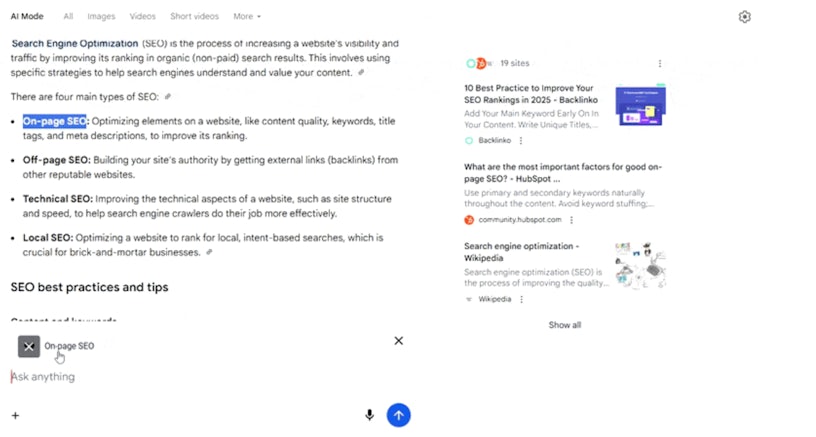
- AI Mode testing text selection for follow-up questions
- Google AI Mode now works in 53 new languages
- Google won't use sitemap files if it's not convinced of new/important content
- Introducing Markdown for Agent
- Controlled experiment on Markdown vs. HTML for AI bots
- Google may be cracking down on self-promotional ‘best of’ listicles

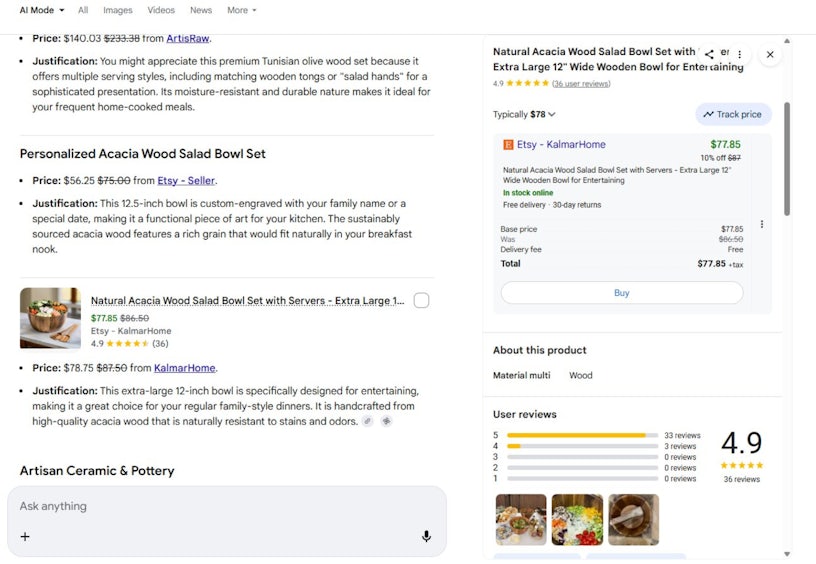
Google has officially launched UCP (Universal Commerce Protocol)-powered checkout within AI Mode and the Gemini app. Currently live in the US for retailers like Etsy and Wayfair (with Shopify, Target, and Walmart soon to follow), this feature introduces a prominent “Buy” button directly within the AI search results. This allows users to handle the entire transaction, from payment to shipping, without ever leaving the Google interface.
This is a significant “zero-click” conversion for e-commerce. If Google becomes the primary storefront and checkout point, the traditional “on-site” customer journey is bypassed entirely.
Here’s the ‘Buy’ button feature:
Google is continuing to build on the conversational flow of its AI search, recently spotted testing new follow-up search suggestions at the bottom of AI Mode responses. Moving away from just full-sentence questions, these new suggestions appear as concise, clickable “bubbles”. These are designed to help users instantly fan out their query, guiding them deeper into a topic without requiring them to re-type a search or return to the standard blue-link results. This update highlights Google’s intent to keep users within its AI ecosystem for as long as possible.
Here’s a look at the new follow-up suggestions:
Google has significantly expanded the global reach of its AI-driven search by adding 53 new languages to its AI Mode, bringing the total to nearly 100. As announced by Google’s Nick Fox, this expansion opens the AI experience to over a billion more users, incorporating major languages such as Arabic, Hindi, Spanish and Urdu. This shift marks the end of an English-centric AI era and emphasises the priority of high-quality, localised content over generic translations.

Google’s John Mueller recently clarified that a sitemap alone cannot force indexing if Google’s systems are not already convinced of a site’s value. This means that Google might ignore sitemap files if they do not perceive the content to be new or important. Whilst sitemaps are useful as navigational tools, they do not guarantee that every listed page will be indexed, as Google prioritises crawl budget based on the authority and overall quality of the domain. Consequently, resolving indexing issues may require a shift away from technical sitemap fixes toward improving the perceived importance of the site’s content.

Cloudflare has introduced a groundbreaking new feature: Markdown for Agents. Recognising that AI crawlers and agents struggle with the weight of traditional HTML, this tool allows Cloudflare-powered websites to automatically convert HTML into clean Markdown on the fly. When an AI agent requests a page, Cloudflare serves a lightweight Markdown version that reduces “token waste” by up to 80% compared to standard HTML.
This is a major move toward Answer Engine Optimisation. By serving Markdown, you are making it significantly easier and cheaper for AI models to crawl, parse, and understand your content. This increases the likelihood that an AI agent will correctly “read” your site and cite it in an AI Overview or conversational response.
While Cloudflare has simplified serving Markdown to AI agents, a recent controlled study by Profound suggests that the format might not be the “ranking hack” many SEOs hoped for. After A/B testing 381 pages, the study found that serving Markdown to AI crawlers resulted in only a marginal increase in bot visits—averaging just one extra visit per page over three weeks. The researchers concluded that while ChatGPT-User showed a slight preference for Markdown, the overall impact was not statistically significant enough to be considered a game-changer.

The era of using self-promotional ‘best of’ listicles as a quick SEO win has hit a roadblock, with recent data showing a significant clampdown on biased rankings. Several prominent B2B and SaaS brands have reported their blog traffic dropping by as much as 50% after being flagged for ranking their own products as the top choice without providing objective testing and clear methods to reaching this conclusion. It appears that search systems are becoming more adept at identifying content that aims to capture top spots in AI results rather than providing genuine value to the reader.
Keep an eye on our blog for the latest Google Algorithm updates, or get in touch if you want to discuss your digital solutions, such as SEO, for 2026 and beyond.