Get in touch with our team

MOTORS

Feed-driven automation strategy delivers 20,000+ monthly leads for online car retailer

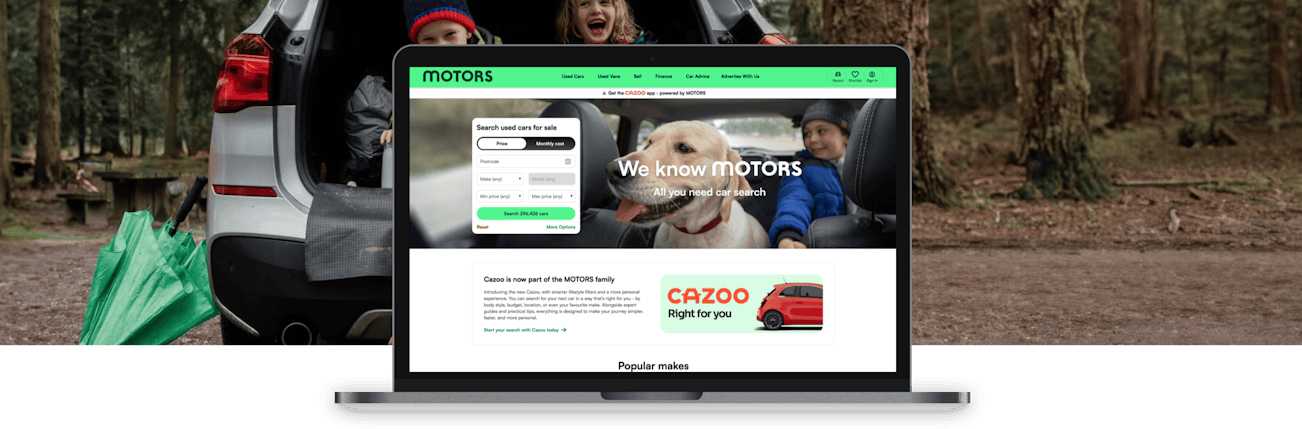
Established in 2007, MOTORS is a prominent online automotive website specialising in nearly new and used cars. With 2.4 million monthly site visits, its automotive site is one of the UK’s largest.

20,000+
Leads generated on average per month (October 2023 - February 2025)
55%
Reduction in CPL

The Challenge

Motors, a leading online platform for buying and selling cars, wanted to make better use of its marketing budget to attract more customers and compete more effectively with both well-known industry leaders and emerging competitors.

We saw an opportunity to tap into Motors’ vast first-party data pool, but several challenges needed to be addressed:

1

Data complexity

Motors’ inventory feed was vast and rich in data, but had a limited structure, providing less variety or customisation, which could impact how effective ads are in reaching the right audience. We theorised that we could pull data from multiple sources into one unified feed.

2

Dealer IDs and data mapping

Unifying data was made more difficult due to how data was stored and formatted, as well as some historical inconsistencies with data collection.

3

Integration with new campaign formats

As a Google Premier Partner, we gained access to the Beta for Google’s new campaign format, Vehicle ads, which had not yet been used in the UK. Whilst this would make us a trailblazer in this space, we found that the format was designed primarily for individual dealerships, not aggregators, meaning we had to find a way to link multiple third-party dealers under a single advertising structure

4

Vehicle prioritisation

By pinpointing the vehicles most likely to perform well, we could focus our budget on those that delivered the best results. We could then fine-tune the targeting and delivery to maximise reach and ROI.

5

Ensuring consistency and quality control

Due to inconsistencies in data, we needed to ensure that we were not serving ads for “sold” cars, and that there was always a reliable image attached to each vehicle.
The Strategy

Our goal was to create a scalable end-to-end solution that would transform multiple data sources into marketing-suitable feeds to not only dynamically power campaigns automatically but to optimise them too.

Data joins and unification

The dealer information and vehicle inventory were stored in separate places, so we needed to combine this data using Google Cloud and BigQuery. Dealer IDs were especially tricky because we had to bring all the related data together. Once everything was unified, we could create one complete feed, which was then formatted to work with platforms like Google and Meta for the ads.

Data cleaning

Due to the size of Motors’ inventory, data impurities were inevitable. Some sold or removed vehicles remained in the feed with links to inactive pages. We identified out-of-stock vehicles through image links showing a default ‘no image found’ picture. To fix this, we set up filtration rules to remove outdated vehicles, exclude outdated images, and eliminate flagged errors from the Google Merchant Center’s diagnostics report.

Dynamic labelling

We wanted to prioritise advertising for high-demand vehicles, so they received more budget. To do this, we created a dynamic hierarchy in the feed, aligning bidding strategies with Motors’ goals. We developed a labelling system that classified vehicles and dealers into tiers, allowing us to adjust bids and focus on high-value vehicles for better campaign efficiency.

Transforming feed for Google Vehicle Ads

Google Vehicle Ads (GVAs) was a Beta ad format using a new feed structure, separate from traditional product feeds. We collaborated closely with Google to understand the feed’s parameters, creating a solution that met the minimum requirements and added extra features to maximise the format and gain a competitive edge.

This involved mapping vehicle attributes like make, model, year, and body type into Google’s required fields alongside each dealership as a store location, linking vehicles to their respective dealers. The feed was also transformed into a Meta-compliant version, which meant we were able to power dynamic ads across both platforms.

The Results

By transforming disparate data into an optimised, scalable solution, we created automated ad campaigns that were quicker to manage and optimise. This improved time efficiency, enhanced targeting and reach, and significantly boosted leads while improving budget efficiency.

20,000+

Leads generated on average per month (October 2023 – February 2025), peaking at 30,000

55%

Reduction in CPL

Talk to an expert

Find out what we can do for your business

Fill out the form, give us a call or drop us an email. We look forward to hearing from you.